
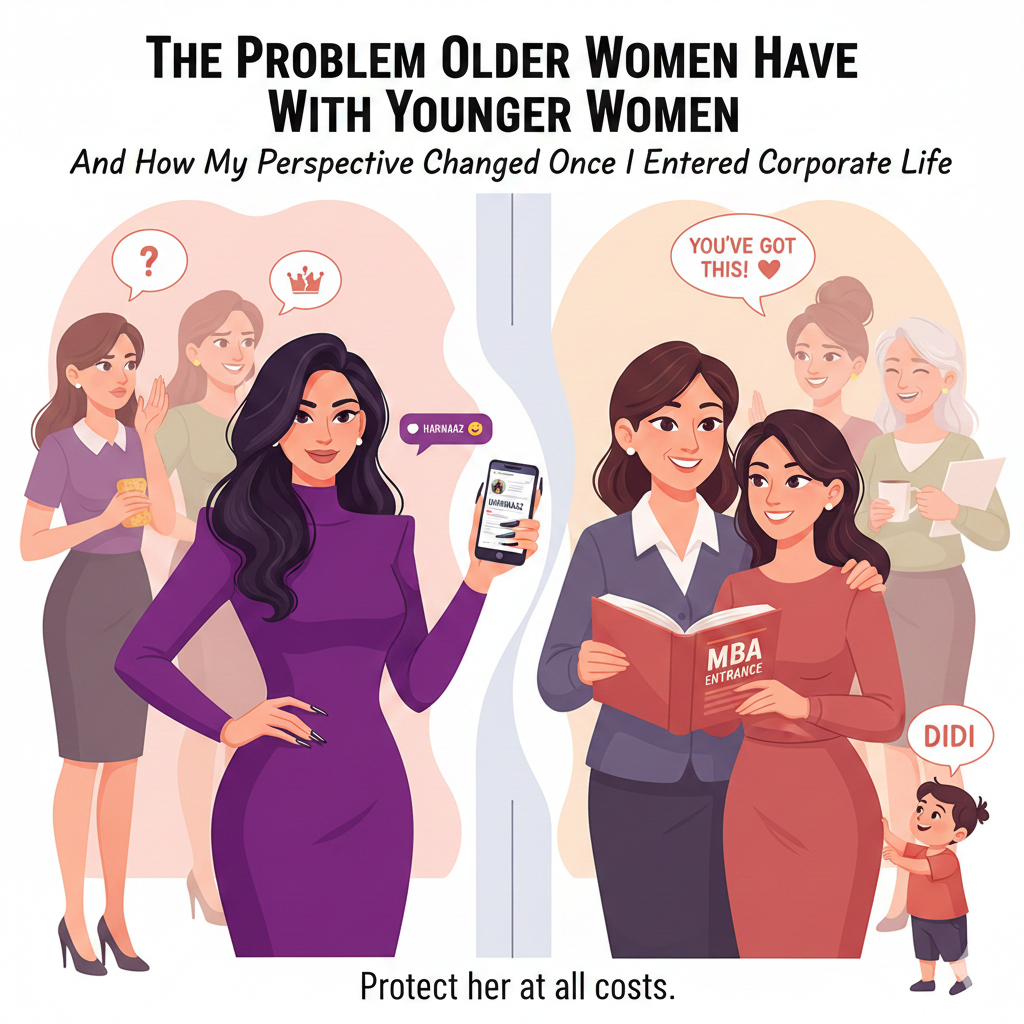
The Problem Older Women Have With Younger Women
(And How My Perspective Changed Once I Entered Corporate Life)
When I was younger, I always saw girls my age as my competition.
Better skin. Better height. Slimmer waist. Healthier hair. You know the deal.
In school and college, the rivalry made sense. You compete within your weight class — academically, socially, aesthetically. I stood first in class, which meant the only direction left to move was downwards. Competition felt structured. Predictable.
It wasn’t until I entered the corporate world that I realized competition doesn’t stay in your age bracket.
It expands. Warps. Gets… strange.
Walking Into My First Office As Her
I was twenty.
Very girly. Very dramatic.
Long nails. Bodycon formals. Hair done. Clothes like I was auditioning to be Fallon Carrington’s corporate cousin. I took myself seriously — and I looked the part too. I was (and still am) into pageants, so hyper-femininity wasn’t occasional — it was default.
My first office had a lot of older women.
And by older, I mean late twenties.
I was thin. They weren’t.
Now before anyone clutches pearls — I’m not saying this to be cruel. I’m saying this because it shaped the dynamic. Your early twenties is when you feel most at home in your body. You dress differently because you feel different.
And I did.
The incidents weren’t explosive. Nothing HR-complaint worthy.
Just… small.
The Harnaaz Sandhu Incident
When Harnaaz Sandhu won Miss Universe, I made a celebratory Instagram post. Through pageant connections, I managed to get her to notice it — and she commented.
I was overjoyed.
One woman at work said,
“Are you sure she commented? Must be someone running her page.”
It was her. I knew people who handled social media for pageant queens. I knew how the industry worked.
But they kept joking about it. Dismissing it. Reducing it.
At the time I couldn’t explain why it irritated me so much.
Now I can.
It wasn’t about Harnaaz.
It was about invalidating proximity to a world they didn’t understand — or perhaps didn’t value.
The Bodycon Thursday
One random Thursday, I decided to dress up.
Formal bodycon dress. Purple. Structured. I looked good — objectively.
Coincidentally, it was a senior’s last working day. I didn’t know — I was new, and farewells in IT aren’t always a big production.
Another woman — around 28 — also wore a bodycon dress. Wine colored.
I received a lot of compliments that day.
And I could feel her eyes on me the entire time.
Now here’s where my personality comes in — I’m self-aware enough to admit this:
If I sense you don’t see me as a friend, I don’t chase approval. I lean into being your enemy.
Petty? Maybe.
But it made me feel like Priyanka Chopra in a rivalry montage. Hate me if you want — you still noticed me.
“Wait Till You Get Married”
Another day, we were casually chatting when a woman looked at my nails and said:
“She’s not married. She doesn’t have to wash dishes. Wait till you get married.”
I remember thinking — wait till you die?
Because what even was that?
It wasn’t about nails.
It was about freedom.
Long nails symbolized a life untouched by domestic labor — at least in her eyes.
Enter: Nupur
Then a new woman joined.
Thirty. Unmarried. Slightly on the heavier side.
Almost immediately, she began passing comments about my clothes.
My mentor — a woman I adored — had never objected. She genuinely wanted me to grow, and she never equated my appearance with my capability.
So I ignored Nupur.
Then my mentor resigned.
And Nupur suddenly tried to get close to me.
One day she told me a senior male colleague had asked her to tell me to “tone down” my dressing.
I was shocked.
Not because how dare he comment on my clothes — though yes, how dare he — but because his mentee was my best friend in office. If he had an issue, he would’ve gone through him.
I spoke to my friend.
He laughed.
Turns out — it was a lie.
The senior had never said anything. In fact, they’d spoken about me before — never about my clothes.
He was ready to confront her. We stopped him.
Because then she’d know we were close.
For what it’s worth — she got married this year.
And now dresses like me.
Do with that information what you will.
Why I Had More Male Friends
This phase explains why most of my office friendships were with men.
Not because men are inherently better.
But because I wasn’t in their comparison category.
There was no body competition. No beauty hierarchy. No marriage timeline comparison.
The dynamic was simpler.
It reflects this idea that a woman’s time becomes valuable only after marriage or motherhood.
The Shift In Woman-Centric Workspaces
My next two organizations were male-dominated.
Now I’m back in a women-centric workplace.
And my perspective has changed.
Once women cross forty, something shifts.
They stop seeing twenty-somethings as competition.
They see us as children.
My boss and her colleagues treat me like their group baby. They’re more invested in my MBA entrances than I am.
And I love it.
It feels protective. Warm. Maternal, almost.
But Internalized Misogyny Still Exists
Not everything disappears with age.
For example:
I reach office early and leave early because I live far and don’t want to reach home late.
One woman asked:
“Why do you rush home? It’s not like you have a child or have to cook.”
Men have said similar things too — but coming from women, it lands differently.
The “Didi vs Aunty” Politics
Another colleague has a teeny bit issue with her two-year-old calling me didi instead of aunty.
Which — I agree — is technically valid.
But I never asked the baby to call me didi.
He chose that title himself.
And honestly, I don’t think it’s a problem.
If anything, it’s funny how even toddlers accidentally expose adult age hierarchies.
What I Understand Now
I used to think older women had a problem with younger women.
Now I think the problem is more layered:
- Different life stages sharing one workspace
- Youth vs experience comparisons
- Marriage and motherhood hierarchies
- Beauty standards colliding
- Freedom vs responsibility projections
Some women project.
Some compete.
Some nurture.
And some heal what they never received by protecting younger women.
The Full Circle
If anything, corporate life taught me this:
Not all women will support you.
Not all women will compete with you either.
You’ll meet:
- The insecure comparator
- The silent observer
- The maternal mentor
And if life is kind, you’ll grow into the third.
Maybe one day, I’ll watch a dramatic twenty-two-year-old walk into office in a bodycon dress and long nails…
And instead of rolling my eyes, I’ll think:
Protect her at all costs.
Because I’ll remember what it felt like to be her.

Leave a Reply