
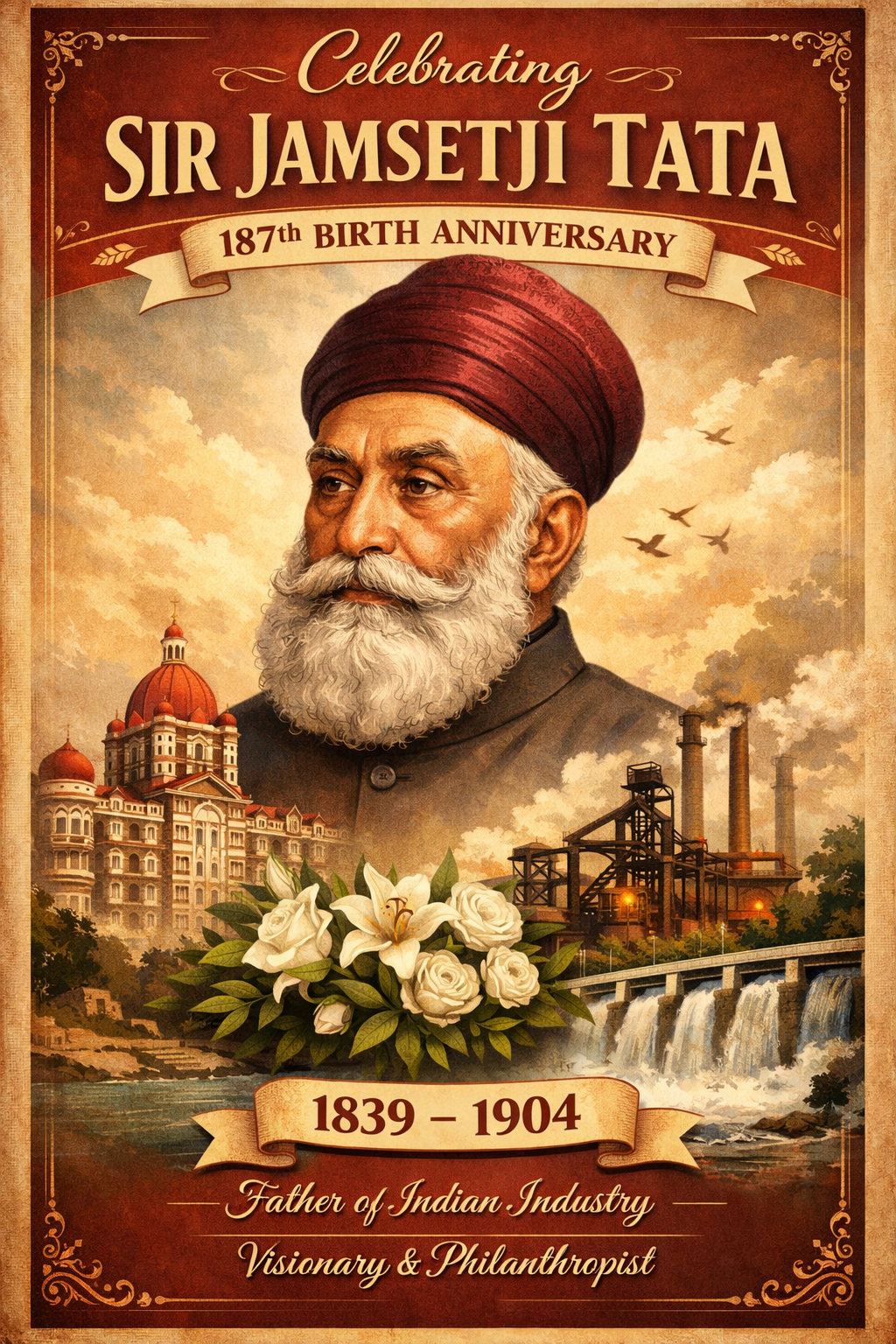
Today is the birth anniversary of Jamsetji Tata – and if there’s one thing I respect deeply, it’s audacity with vision.
Born on March 3, 1839, when India was still under British rule, Jamsetji wasn’t operating in a free, ambitious, startup-India ecosystem. He was building in a colonised country that wasn’t even allowed to dream properly. And yet – he dreamed in steel, electricity, and science.
Not small dreams. Structural dreams.
Steel – Because You Can’t Build a Nation Without Backbone
When Jamsetji envisioned a steel plant, people thought it was impractical. India? Competing in steel? During that era?
And yet that dream became Tata Steel – the foundation of industrial India. Entire cities like Jamshedpur exist because one man decided India deserved industrial power, not dependency.
That’s not business strategy. That’s nation-building with intent.
Power – Because Progress Needs Energy
Before electricity was widespread in India, he was already thinking about hydroelectric power. That vision later evolved into Tata Power, helping electrify industries and cities.
He wasn’t reacting to demand. He was predicting the future.
Education – Because Brains Matter More Than Buildings
This is my favourite part.
Jamsetji believed India needed advanced scientific research. That belief eventually became the Indian Institute of Science (IISc) in Bengaluru – one of India’s most prestigious research institutions.
Imagine prioritising research in a country that was still fighting for dignity.
He understood something most people still don’t: you cannot build long-term power without intellectual infrastructure.
The Taj Mahal Palace – A Statement, Not Just a Hotel
When he built the Taj Mahal Palace, Mumbai in 1903, it wasn’t just about hospitality. It was about standards.
There’s a popular story that he built it after being denied entry into a European-only hotel. Whether that exact incident is true or not, the symbolism is powerful. Instead of complaining, he created something better.
Electric lights. Elevators. Modern design. In 1903 Bombay.
He didn’t beg for access. He built alternatives.
Why Jamsetji Tata Still Matters Today
In a time where “business success” is often reduced to valuation numbers and funding rounds, Jamsetji Tata represents something radically different: responsibility.
He didn’t just accumulate wealth. He structured industries. He embedded philanthropy into the DNA of his ventures. He thought in decades, not quarters.
And the most fascinating part? He didn’t even live to see many of his biggest dreams fully materialise. He passed away in 1904. Others carried his blueprint forward.
That’s legacy. Not noise. Not hype. Not momentary relevance.
On his birth anniversary, I’m not just remembering a businessman. I’m acknowledging a man who designed the skeleton of modern India long before independence.
And honestly? That level of foresight deserves more than a polite tribute post. It deserves respect.

Leave a Reply