
I’m a pageant fan. And I’m not just any pageant fan, I qualify for the psycho tier.
And by now you know my psychopathy leads me to great things in life – which is the point today.
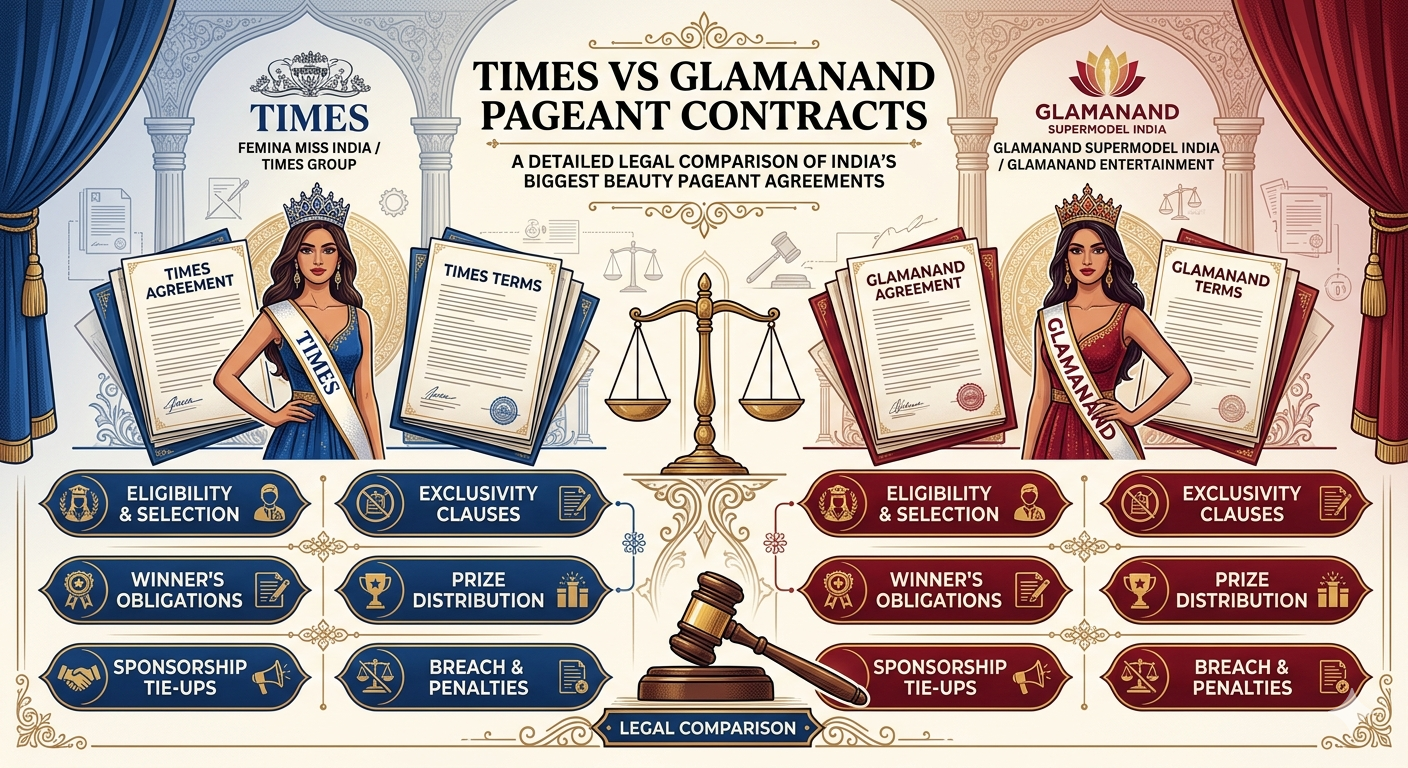
I got my hands on the contracts of two of India’s biggest national organisations – The Times Group and the Glamanand Group. Teehee✌🏻.
Ever since I started watching beauty pageants, I’ve heard a lot of things about a LOT of things – contracts being one of them. Times girls have spoken about the rigid contract they have, and in a similar fashion, so have the girls of Glamanand Supermodel India.
This has put me on a power trip, so today, we shall compare the two contracts and figure out which organisation is safer, contract wise, to be a part of.
Introduction: Why Beauty Pageant Contracts Exist in India
Before we start tearing clauses apart and ranking which organisation is better, let’s establish something important.
These contracts do not exist because organisations are evil.
They exist because pageantry is not charity.
When a national organisation selects a contestant, they are not just giving her a crown. They are:
- Investing in grooming, styling, travel, media exposure, PR and branding
- Leveraging their hard earned reputation and industry relationships
- Associating their brand equity with her public image
- Taking on financial risk in the hope that she succeeds
When a contestant rises, the organisation rises with her.
Without pageants, we might never have had global figures like Aishwarya Rai, Sushmita Sen, Lara Dutta or Priyanka Chopra as we know them today.
Contracts are set in place to protect investment.
If an organisation is spending money, time, brand capital and influence on you, they will expect structure, exclusivity and return on that investment. It’s like marriage.
That is normal.
So the real question is not why these contracts exist, but it’s how much control is reasonable in exchange for their investment.
At what point does protection of business interests become overreach into a contestant’s long-term autonomy?
That is what this comparison is about.
Not villainising organisations.
But understanding power.
Because pageantry is a two-way street.
And like every partnership – the fine print matters.
That being said, it’s finally time to look at the clauses.
This analysis is based on the latest available Glamanand and Times agreements (2025).

1. Term & Lock-In Period: Times Group vs Glamanand Contract Duration Comparison
The Times Group has a 3 year contract period for all contestants of their pageants, however, the top 5 of their pageant is bound by a 5 year contract – which is extendable depending upon your success.
So in case you get a movie, or a series, or a music video during this period, the contract gets extended by five years. The bigger you get, the longer the commitment.


The Glamanand contract establishes a 2 year initial term. Contestants who place in the Top 10 or are later selected for international representation are automatically extended to a total of 5 years.
Additionally, if a contestant signs any media project, the contract extends to 10 years automatically, without requiring any further consent from the contestant.

Verdict: Both organisations operate on long-term control models tied to success. However, Glamanand is more rigid in structure (automatic 10-year lock-in), while Times is more conditional but still extendable.
2. Money Control & Termination Fees: Financial Exit Clauses in Pageant Contracts
Glamanand allows termination with 3 months’ notice and ₹10 lakh in damages. In cases of misrepresentation or breach, this amount becomes ₹50 lakh.
In case of termination of contract, the contestant is still required to fulfil all their prior commitments.


The Times Group agreement is slightly different.
And by slightly, I mean I would rather die.
- Termination fee: ₹50 lakh
- Films: ₹2 crore
- Music video: ₹65 lakh
- Web/TV: ₹1.5 crore


Additionally, the contestant may also be required to refund revenue and costs incurred by the organisation, depending on the situation.
Verdict: Glamanand is still more financially survivable than Times. Times creates high financial exit barriers that scale with your success.
3. Lifetime Royalty Clause: Do the Organizations Claim Earnings in Perpetuity?
The Times contract includes a 3% royalty on all earnings, in perpetuity, across all professional work.

Glamanand does not include a lifetime royalty clause in the main agreement.
Verdict: Glamanand wins clearly. Times effectively creates a lifetime financial stake in the contestant’s career.
4. Intellectual Property & Image Ownership in Indian Beauty Pageant Contracts
Glamanand holds perpetual rights over all media, including personal footage and written content created by the contestant.

The Times contract extends this further into AI, NFTs, and future technologies.
- All media (during and after contract)
- Likeness
- Recordings
- AI avatars
- NFTs
- Metaverse versions
- Future tech representations


Additionally, any AI/digital avatar created from the contestant’s identity is owned in perpetuity, with revenue sharing favouring the organisation.
Verdict: Both organisations retain long-term ownership over identity and content. However, Times is significantly broader and more aggressive.
5. Termination Rights & Power Balance: Who Holds More Control?
Both organisations retain the right to terminate contracts unilaterally. For contestants, however, exiting the agreement is significantly more restrictive, as discussed above.
However, the Times contract explicitly allows termination without cause with notice, while still retaining post-termination rights such as intellectual property and ongoing obligations.
Verdict: Power remains heavily skewed toward the organisation, but Times exercises a stronger unilateral control structure.
Final Verdict: Which Indian Pageant Contract Is Safer for Contestants?
Glamanand Contract
- Structured talent management model
- Long-term lock-ins (up to 10 years)
- Exit is possible (at a cost)
- Legally survivable
Times Contract
- Corporate ownership model
- Lifetime monetization
- High exit barriers
- Deep control over identity and earnings
Glamanand is the safer contract overall.
Not because it is lenient.
But because it is finite and escapable.
The Times contract, on the other hand, is designed for maximum long-term extraction of value.
You are not just a contestant.
You are not just a brand.
You become a managed, monetized asset.

Leave a Reply