
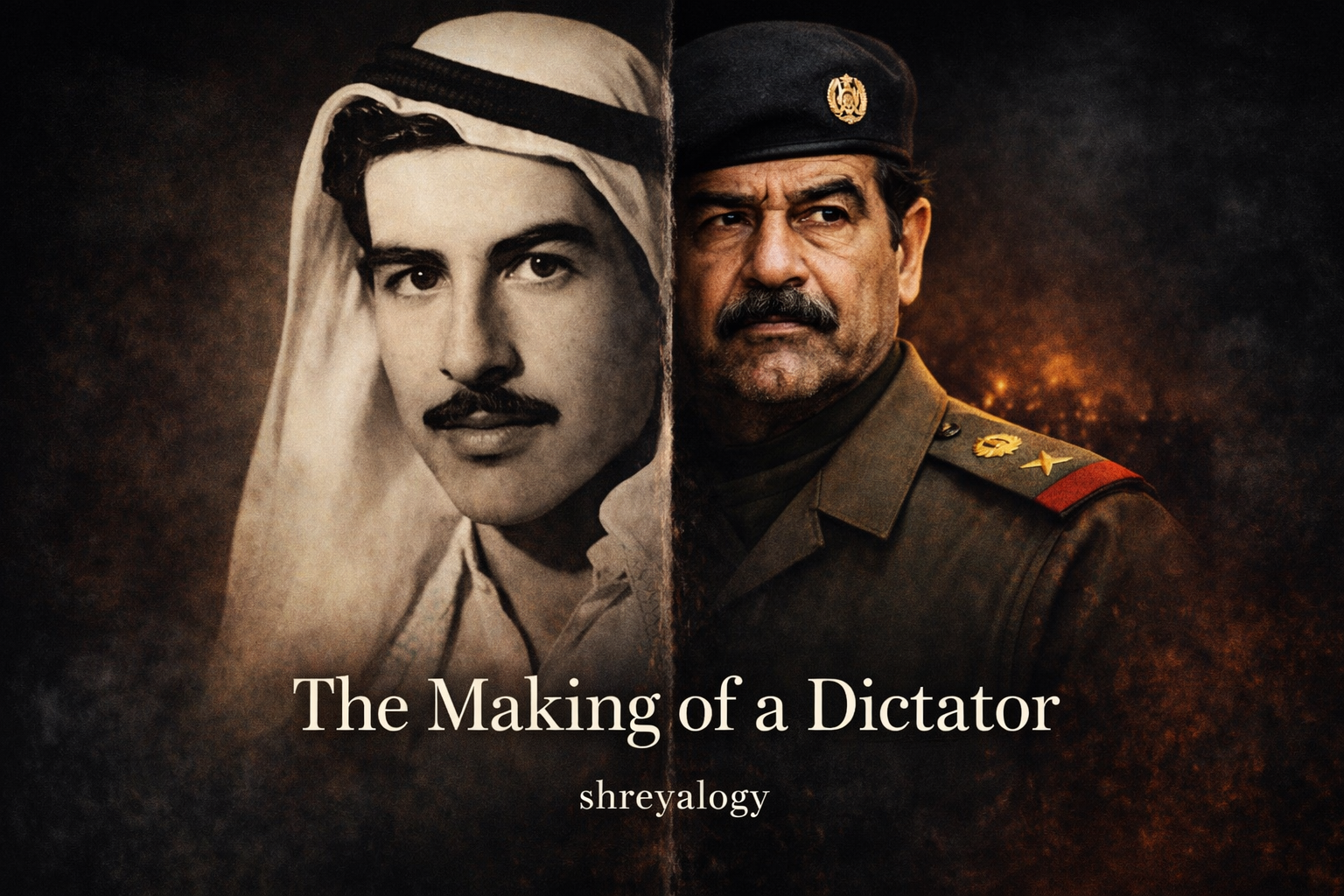
You know I’m a little messed up. And the thing about a little messed up people is simple – we can think, ask, and say anything that comes to mind. Because we are messed up, what’s the worst people will think?
See, being weird is actually such an advantage.
So anyway, the other day I heard a random content creator make a song about how dictators used to be hot. And the first dictator in his multiple-part song was Saddam Hussein.
Now, whether he was attractive or not is highly debatable – but it made me realize something.

As a member of the Gen Z community, I hate him… but I’m not entirely sure why. Man was hanged to death in 2006 – I was learning how to hold a pencil back then.
Because hating someone without knowing why feels – i don’t know – propaganda? It feels inherited. Like I downloaded an opinion instead of forming one.
And I think this is where Gen Z wins — because we ask questions.
So anyway, Gen Z to the world — here’s the story of Saddam Hussein.
Saddam Hussein’s Early Life: Trauma, Childhood Abuse & Origins of Power
To give him some credit — his life was messed up right from the beginning.
No actually, from before the beginning.
His father died before he was born. His mother fell into deep depression, tried to abort him, and even attempted suicide. Neither happened, well because “god works in mysterious ways” I guess.
But imagine that for a second.
Before you even exist, the world has already decided it would be better without you.
Which is exactly why the anti-abortion thing the world is currently debating on makes no sense. I get it. Killing an unborn baby is theoretically bad – but you know what’s worse? Having a baby you didn’t want and wouldn’t care for.
Saddam was born — unwanted.
Not unloved later. Not misunderstood. Unwanted from the start. From before his start.
His mother didn’t want to raise him. She wanted nothing to do with him. He was neglected and eventually taken in by a stepfather who was extremely abusive and beat him regularly.
There’s a kind of loneliness that comes from being hit by the people who are supposed to protect you. Especially at an age where you can’t protect yourself. That level of helplessness justifies every evil act you inflict on others later in life.
Because it doesn’t just hurt your body, it rewires your idea of love.
Saddam ran away at the age of ten.
Ten.
That’s the age you’re supposed to be worried about homework and cartoons. Not survival.
He ran from Tikrit to Baghdad, where his other uncle – Khairallah Talfah – took him in. This man became his father figure.
Talfah was a veteran who had fought against the British and had been imprisoned for it. He filled young Saddam’s head with stories of war, humiliation, revenge, and pride.
And suddenly, the world makes sense to a child like that.
Violence has logic. Power has meaning.
So let’s summarise:
- His mother didn’t want him
- His stepfather abused him
- He ran away as a child
- He was taken in by his uncle who was a war veteran
- His role model was a war-influenced nationalist
I’m no cook, but I know this recipe very well.
And honestly? Stop traumatising children – history has proven we cannot afford that.
At around the age of 20, Saddam dropped out of college and joined the Ba’ath Party — a political movement that believed in uniting all the Arab nations. His aim was to get closer to Ahmed Hassan al-Bakr, a leader for this party – who’d later go on to become the president of Iraq.
Before this point, he wanted to be a schoolteacher.
Which is honestly so sad because somewhere in there was a version of him that wanted to teach kids.
And that version never got a chance. Because the world is such a cruel place.
Saddam Hussein’s First Assassination Attempt: The 1959 Plot Against Qasim
In 1959, Iraq was led by Prime Minister Abdul Karim Qasim.
The Ba’ath Party wanted him dead.
Why? Because while they believed in a united Arab identity, Qasim believed in “Iraq first.”
The assassination plan was ready. But at the last moment, one of the attackers backed out, which in my opinion was very brave because this decision could’ve got both him and his family killed.
So they recruited Saddam as a backfill.
And here’s when we realise our behated dictator was also actually a dumbfuck.
His role in this mission was to provide cover.
But our wannabe gangster decided otherwise. On the scene, Saddam started shooting prematurely, disorganising the whole operation.
Qasim’s driver was killed in the ambush and Qasim too suffered a few injuries but survived.

And just like that, a plan turns into chaos, and chaos turns into consequence.
Saddam along with his co-conspirators was exiled and had to flee Iraq and escape to Cairo. During this exile, he tried studying law. That’s really funny for someone that was later executed for human rights violations.
Eventually, Qasim was overthrown and killed in a separate coup without Saddam’s involvement. Saddam returned to Iraq after Qasim’s successful assassination.
Rise of Saddam Hussein: How He Became President of Iraq
Saddam didn’t rise in a moment.
He rose in silence.
In observation. In patience.
In 1968, the Ba’ath Party took power. Ahmed Hassan al-Bakr became president — and Saddam became his deputy. Remember the guy that Saddam wanted to get closer to? Yes, this is him. This is the guy that Saddam followed into politics.

But power isn’t always in titles.
It’s in control.
He controlled the security forces. He controlled intelligence. He controlled fear.
And once you understand fear, you don’t need to shout to be powerful.
In 1979, during Saddam’s daughter’s birthday party at Saddam’s palace – he asked al-Bakr to resign. He had gained more supporters in the party and made it clear that if al-Bakr refused he’d still be forced to step down and declare Saddam as his successor.
No noise. No resistance.
Just power.
The 1979 Purge: How Saddam Hussein Eliminated His Rivals
This is where things get dark.
Shortly after becoming president, Saddam held a meeting of party members.
The entire thing was recorded.
One of the party leaders was made to confess to conspiring against Saddam.
A list of 68 alleged “traitors” was read out. One by one, people were taken out of the room.
They were later executed.

And here’s the most disturbing part:
Other party members were forced to participate in the executions.
Loyalty wasn’t just expected. It was enforced through fear.
And again, if I was a dictator — I’d probably do the same.
Was Saddam Hussein Pure Evil? Development, Power & Contradictions
Here’s where things get uncomfortable.
Because while Saddam was brutal — he also built things.
And not small things.
Entire systems.
Iraq, for a period of time, worked.
There were roads. Electricity. Cities that looked like they were moving forward.
Education was free. Literacy improved. Universities expanded.
Hospitals existed. Healthcare was accessible.
Women had access to education and jobs in ways that were relatively progressive for the region at the time.
For a moment — a real moment — Iraq was rising.
And that’s what makes this harder.
Because it would be easier if he had only destroyed.
But he didn’t.
He built and broke at the same time.
The Fall of Saddam Hussein’s Iraq: War, Sanctions & Decline
Most of the things he built relied heavily on the money Iraq earned for oil.
For a brief period, Iraq believed Kuwait was stealing their oil and selling it at a cheaper rate – which was depleting the Iraqi economy.
Thus followed decisions that resulted in the downfall for both Iraq and its leader – Saddam Hussein.
War with Iran.
The invasion of Kuwait.
Sanctions.
Isolation.
Everything that had been built started collapsing.
The US Invasion of Iraq: Weapons of Mass Destruction & Power Politics
Now here’s my controversial take.
The world would be a much better place if the United States just… stopped.
Yes, Saddam was a dictator.
Yes, he committed atrocities.
But invading Iraq over weapons of mass destruction that were never found?
That’s not justice. That’s power.
And if power is the justification, then how is that any different from the very dictators we criticise?
You don’t get moral superiority just because you win. And it’s not okay when you do it because you’re white.
Was Saddam Hussein Evil or a Product of His Past?
Saddam Hussein was a dictator.
He caused immense suffering.
But he was not a cartoon villain.
He was a human being who became dangerous.
And here’s the part that more and more people need to understand:
The pain of one child is always bigger than the pain of a million adults. Because believe it or not – we are in control. We can fight back. We have some role in what’s being done to us. A child has none of that. Torturing a child is far far far worse than torturing a planet full of adults.
And when a tortured child grows up to have power, he will give to society what society gave him when he was powerless.
Saddam was that child.
Are Monsters Born or Made? Understanding Dictators Like Saddam Hussein
We love calling people monsters because it simplifies things.
Because if they were always monsters, then we don’t have to ask uncomfortable questions.
Like — what created them?
What failed them?
What could have been different?
Monsters are not born.
They are made.
And if we don’t understand how — we will keep making them.

Leave a Reply