
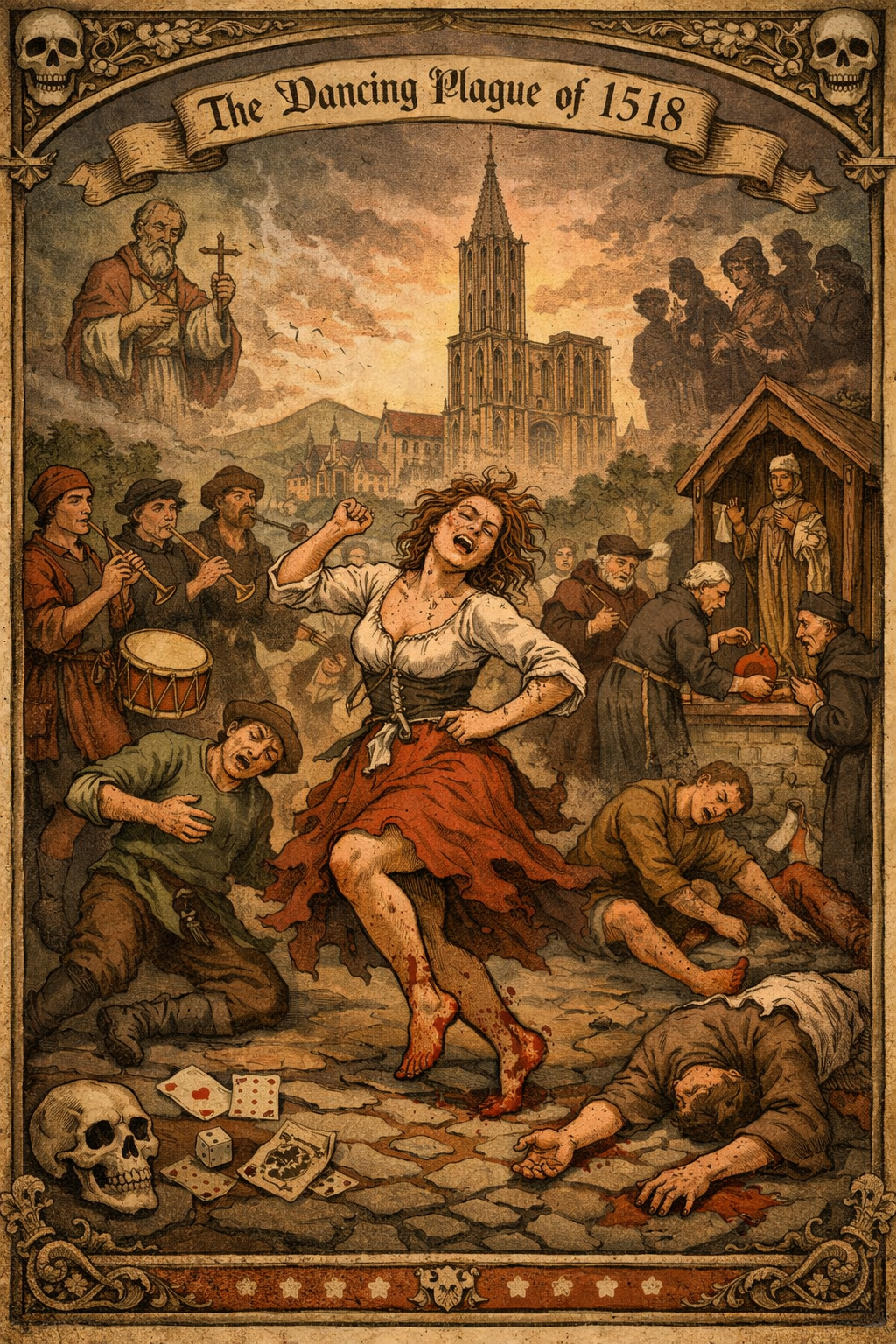
What Is the Dancing Plague? A Strange Historical Mystery
Today, in 2026, the majority of the world’s population believes in what we call “science,” and while there’s still a huge chunk of this population that also believes in the existence of God and the supernatural, science has been successful in establishing itself as the most trusted source of explanations on the planet.
However, the world has a huge history, and while science has cracked a lot of it, it has still only discovered the tip of the iceberg. The Earth has been around for nearly four and a half billion years, and in these four and a half billion years, countless bizarre and rather unsettling instances have occurred that science still cannot fully decode.
One such event was the dancing plague of the 1500s.
The name itself is so intriguing because how can there be a dancing “plague”? That simply makes no sense. What was this plague even about? Dancing? Ridiculous.
Except, that’s exactly what it was.
Dancing. People danced. That was the plague.
The Dancing Plague of 1518 in Strasbourg: What Happened?
In the 16th century, the city of Strasbourg, situated near the Rhine River close to the German border, was known for its cultural blend influenced by both France and Germany, its Gothic architecture, and its importance as a European center. It was, in many ways, one of the “IT” cities of its time.
On one unsuspecting day in 1518, a housewife named Frau Troffea was out in her yard when she started dancing to a rhythm no one else could seem to hear. She danced and danced and danced the whole day, only stopping at night to sleep for a few hours. The next day, she resumed again. This would be important for a later portion of this article.
By this time, her feet were bleeding, and it was clear that she was in pain, but no one could figure out what was wrong with her.
Suddenly, more and more people started to join in — dancing till their feet bled, dancing until collapse from exhaustion. Within a week, around thirty people had joined Frau Troffea in this mania, and no one knew what to do about it.
More and more people started to join in, and in about a month, more than four hundred dancers were part of this phenomenon. People danced and danced and danced — until their feet bled, until they collapsed from a heart attack, fainted due to dehydration, or simply dropped dead.
Some historical accounts suggest that deaths may have reached a daily number of fifteen or more, though modern historians debate this figure.
Imagine streets filled with people dancing in silence — no music, just the sound of feet hitting stone and bodies collapsing one by one.
They really said “dancing until I’m dead.” Lady Gaga must be proud.
The authorities were confused, to say the least — and to be fair to them, how do you even tackle a situation like this?
Failed Treatments: How Authorities Tried to Stop the Dancing Plague
1. Dance Battle as a “Cure”: Why More Dancing Made the Plague Worse
You absolutely read that right. Their solution to the dancing problem was — dancing.
The officials decided that they’d let the people “dance it out.”
To facilitate this, they hired musicians who were supposed to play music for the people to dance to. But that didn’t go exactly as planned. As the steps started to slow down for the dancers, the musicians increased the tempo instead of slowing it down. This forced the dancers to pick up pace again, despite exhaustion.
The worst part? Travellers and other people who didn’t know what was happening just saw a lot of people dancing and decided to join in — for fun. This isn’t an Indian wedding, guys 😭.
I’m so glad we’re in the 2020s.
2. Banning Music and Dancing: Did It Stop the Dancing Plague?
Of course, the next “logical” course of action that anyone could think of was — let’s ban dancing.
Again, I wish I was kidding, but unfortunately, I’m not.
After the failed dance battle attempt, the officials decided it would be best if music and dance were banned. Because dance was the problem, right?
So all types of music, except certain string instruments, were banned completely. String music was allowed to be played if the occasion called for it — for example, at weddings.
People otherwise playing music or dancing casually were punished.
But like any modern human could have guessed — this helped no one.
It’s like banning crimes. Great idea, but that’s just not how it works.
3. Religious Panic and Sin Erasing: Was the Dancing Plague Seen as a Curse?
The next logical course of action was to understand why God was punishing the people of Strasbourg.
The answer? A curse by saints, angered by the sins of the people.
So gambling and prostitution were banned. “Immoral” individuals were either banished or executed.
Did it work? No. But at least the city was morally cleaner. A win is a win.
4. Blaming Women for the Dancing Plague: Medieval Misogyny in Action
Remember the first known case of this plague? A local housewife. A woman — and in 16th-century Europe, that was enough to make her the suspect.
A theory emerged that Frau Troffea simply didn’t want to do household chores… so she faked the entire thing.
Yes. Faked dancing until her feet bled.
A local woman was too lazy to do the dishes, so she danced herself to death.
Flawless logic.
Earlier Cases: Dancing Plagues in Medieval Europe
With everything you know so far, you’d think this was such a weird and unique occurrence.
It wasn’t.
In 1374, Rhineland Germany saw a very similar — almost identical — dance outbreak. Thousands of people danced uncontrollably in the streets, markets, and churches for days or weeks, unable to stop, until they collapsed from exhaustion or injury.
This was also called St. John’s Dance because many believed that he was the one causing it.
Now, do you recall where Strasbourg is located? Near the Rhine River. And can you guess where Rhineland must be?
Interesting. Very interesting.
How the Dancing Plague of 1518 Ended
So we will never know for sure, but records suggest that people finally turned to the Christian martyr St. Vitus for mercy.
The most afflicted dancers were taken to the shrine of Saint Vitus in Saverne, where priests placed them under a wooden carving of the saint, handed them small crosses, and placed red shoes on their feet, which had been blessed with holy water and anointed with oil.
According to contemporary accounts, this ritual appeared to be successful, as the frenzied dancing finally began to subside by September 1518.
What Caused the Dancing Plague? Theories Explained
1. Mass Hysteria (Most Accepted Theory)
The most widely accepted explanation.
This happened during a period of great misfortune for Europe.
Extreme stress from famine, disease, and hardship triggered a psychological condition that spread through the population.
This is the most acceptable theory for the strange event, because science can best explain it this way.
2. Ergot Poisoning Theory
Ergot is a fungus on rye that causes hallucinations. Many people believe the town was a victim of this ergot fungus consumption, resulting in the mass hysteria.
This theory, however, has few believers, as Ergot poisoning is known to causes convulsions — not sustained dancing.
Conclusion: Why the Dancing Plague Still Fascinates Us
The Dancing Plague remains one of history’s strangest mysteries.
Hundreds of people once danced uncontrollably — some even to their deaths — and we still don’t fully know why.
Science has theories. Religion believes it has answers.
But neither has complete authority over this story.
And that’s the most unsettling part.
I’ll be back with more weird stories from the past — because that’s just what I do now.
Until then, bye.

Leave a Reply