
Introduction
In this corner of the internet, we love talking about monsters.
We dress them up in clean narratives—serial killers with patterns, villains with motives, crimes that make sense if you stare at them long enough. There’s a strange comfort in that. Because if evil can be explained, maybe it can be contained.
But then there are cases like Yvonne’s.
And suddenly, the monster isn’t just a man.
It’s a system.
It’s power.
It’s silence.
It’s everything that lets a crime happen… and then keeps letting it happen long after the blood has dried.
Who Was Yvonne Jonsson?
Yvonne Annette Jonsson was just 19 years old.
That’s not an age—it’s a pause. A space between who you were and who you’re about to become. The kind of age where your biggest decisions are supposed to be about dreams, not survival.
She was Swedish-Sri Lankan, studying fashion design in the United States, and visiting Sri Lanka at the time of her death.
Strong-willed, protective, and deeply intuitive, Yvonne had already sensed something was wrong long before that night.
Because the man who would later kill her wasn’t a stranger.
He was someone already in her life.
The Royal Park Murder: What Happened That Night?
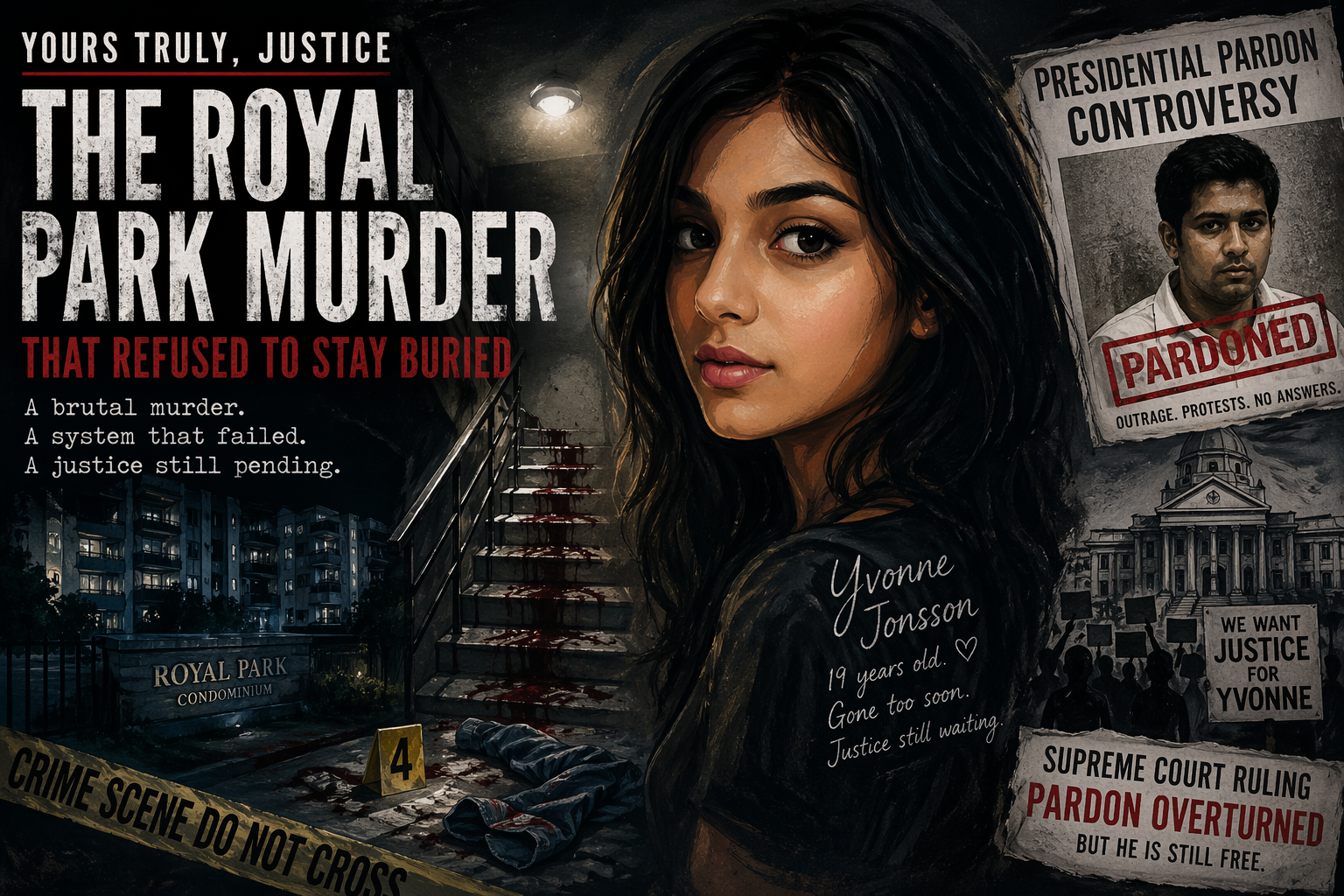
On July 1, 2005, around 2:50 AM, Yvonne returned to the Royal Park condominium in Sri Lanka.
She never made it safely inside.
In the stairwell of her own building, she was confronted by Jude Shramantha Jayamaha—a 19-year-old from a wealthy and influential background, who had been dating her younger sister.
Yvonne strongly disapproved of him.
That confrontation turned fatal.
What followed wasn’t sudden. It wasn’t a momentary lapse of control.
It was prolonged, violent, and deliberate.
- She was dragged down four floors
- Her head was slammed repeatedly against concrete steps
- She was strangled with her own clothing
This wasn’t just murder.
This was rage, stretched out over time.
The Crime Scene and Aftermath
Her body was discovered hours later in the stairwell.
There were clear signs of struggle. Of resistance. Of a fight she did not win—but refused to surrender easily.
And then came the part that makes this case even harder to process.
After killing her, he didn’t run in panic.
- He cleaned himself in the building’s swimming pool
- He went home
- He texted people casually
- He visited her family pretending to grieve
He even offered to help find the killer.
There is something deeply disturbing about violence.
But there is something even darker about returning to normalcy right after committing it.
Arrest and Initial Sentence
He was arrested the very next day.
There was evidence. There were witnesses. There was enough to build a clear case.
And yet—
The initial sentence was just 12 years.
It felt like the first betrayal.
Because when a crime is this brutal, a lenient sentence doesn’t just fail justice.
It rewrites the value of the victim’s life.
Appeal, Death Sentence, and Public Reaction
Following public outrage, the case was appealed.
The charge was upgraded to murder.
The sentence: death penalty.
For a moment, it felt like the system had corrected itself.
Like it had finally acknowledged the weight of what had happened.
But this case was not done breaking expectations.
The Presidential Pardon Controversy
Years later, in a move that shocked the public, the Sri Lankan President granted him a presidential pardon.
He walked free.
No explanation that felt sufficient.
No reasoning that matched the brutality of the crime.
And suddenly, the case stopped being just about a murder.
It became about power.
About influence.
About how easily justice can be undone.
Supreme Court Reversal — But Too Late
In 2024, the Sri Lankan Supreme Court overturned the pardon, calling it unconstitutional.
It was a rare moment of accountability.
But by then—he was gone.
Out of the country.
Out of custody.
Out of consequence.
And justice, once again, arrived to an empty room.
Why the Royal Park Murder Still Haunts Us
This case lingers—not just because of what happened, but because of everything that followed.
- A young woman tried to protect her family
- A man responded with extreme violence
- A system failed, corrected itself, and failed again
And in the end—no closure.
Just a question that refuses to go away:
What is justice worth… if it can be reversed?
Conclusion
She is still 19.
Frozen in time at the moment her life was taken.
He is somewhere out there, living a life that continued.
And the system?
Still trying to convince us it works.
Maybe the real horror isn’t the crime itself.
Maybe it’s the realization that sometimes—even when everything is clear—justice is still negotiable.

Leave a Reply