
Tragedies happen all the time. They come knocking on your door like that one relative everybody hates.
For me, the biggest tragedy is when a parent loses a child. Because that’s something no one prepares for. We all grow up knowing there will be a day when our parents will leave us. Grandparents — even earlier. Friends, cousins, neighbours — everyone is destined to go.
But we forget, so can our kids. People bring kids into this world thinking they will have support for their old age. They spend their entire life dedicating it to these children — never understanding that they are in fact as mortal as you and me.
This story begins with something ordinary.
A dinner.
A quiet home in Ahmedabad.
A family of four.
And a plate of dosas.
Nothing about that night felt unusual. Nothing that would hint at what the next morning would bring.
The first sign was sickness.
Nausea. Vomiting. Weakness. Food poisoning.
At first, it seemed manageable — like something that would pass. We’re Indians, it’s against our pride to go to the doctor for minute ailments.
Maybe the batter had gone bad. Maybe it was just one of those things families deal with and forget.
But this didn’t pass.
It escalated. Two days passed
Their three month old, breast fed baby girl — Raha, died in April 4. Her older sister, four years old Mishri, died the following day.
And just like that, within days, two little girls were gone.
One just three months old.
The other barely four years.
The house that had been full of routine was now filled with silence.
And grief.
The explanation came quickly.
Food poisoning.
It made sense, didn’t it?
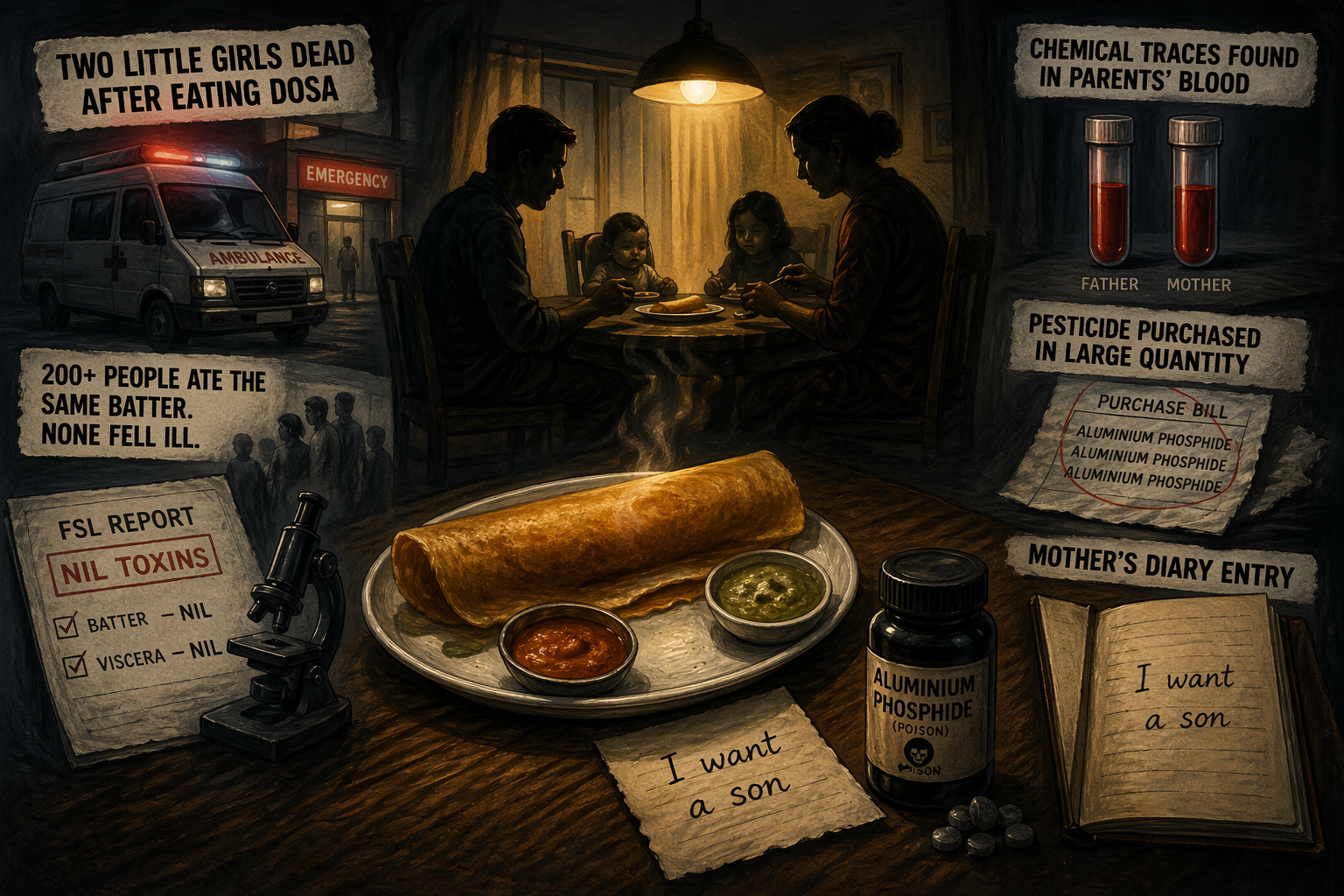
They had eaten the same meal. The same dosas. The same batter.
People nodded. Tragedies like this, as cruel as they are, at least feel explainable when there’s something concrete to blame.
But that’s too easy. That’s too simple for a case like this.
Because somewhere else in the city… nothing happened.
Dozens, maybe hundreds of other customers of the dosa guy, had consumed batter from the same source.
They were fine.
No hospital visits. No symptoms. No deaths.
Just normal mornings. Normal lives.
And then, a quieter question began to surface.
A question people didn’t say out loud at first. A question this world should have never have had to ask.
And then the tests came back.
The batter? Clean.
The children? No clear toxins.
Which should have been reassuring, had they had been alive. But they weren’t. And this was very unsettling, because now there was no explanation left.
Then came something else. The mother was sick. Her blood reports came back.
Traces of a chemical, aluminium phosphide — commonly used as pesticide — found in her system.
How did she consume a pesticide?
And that’s how the case took a turn.
Fragments of information that didn’t fit the “accident” narrative started to get noticed.
And then came the intent:
A recorded desire.
For a son.
Because of course this happened because they had TWO daughters 🙂.
The tragedy didn’t change in that moment.
But its meaning did.
What was once a case of unfortunate food poisoning…
Began to look like something far more deliberate.
Far more calculated.
And then, the thought that no one wanted to say but always had in their mind:
This wasn’t the dosas.
It may have been about the people who made them.
The parents. If God exists, he must be ashamed, for there are people out there begging him for a child — when he lets people like these exist and also have children.
This story doesn’t end as a tragic accident.
It ends as something much darker:
A home.
A meal.
Two children.
And the possibility that the danger was never on the plate — but sitting at the table all along.
Two little lives lost at the hands of people that didn’t even deserve to have babies.
For anyone with two unwanted baby girls, look around — there’s people out there that would happily take in your burden and love her like God personally gifted her to them. There’s orphanages all around, it’s not that hard. Suicide is also a better option for you, just leave the baby girls alone.

Leave a Reply