
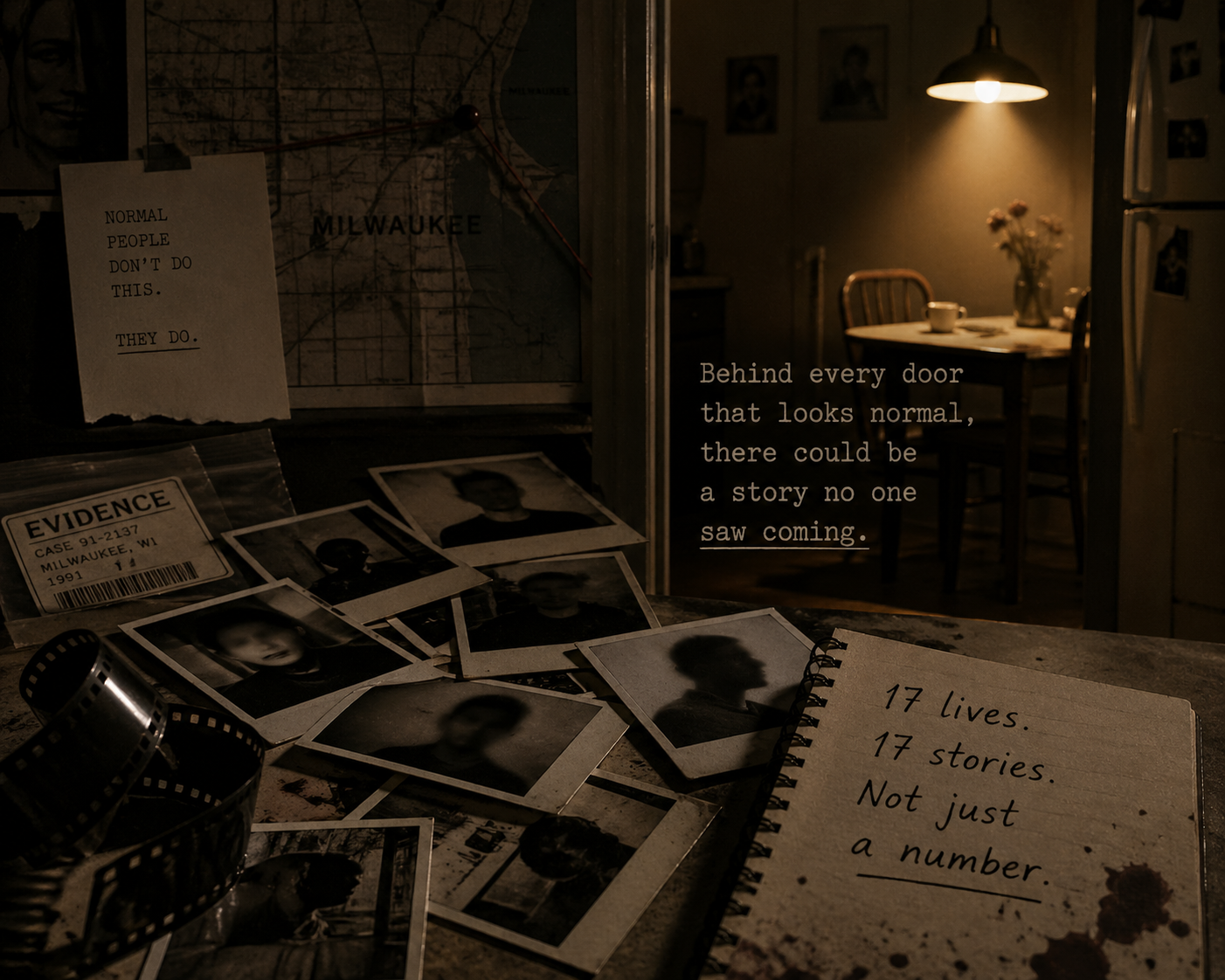
There are crimes that shock you.
And then there are crimes that make you uncomfortable in a quieter, more unsettling way—because they don’t look like what you thought evil would look like.
This is about Jeffrey Dahmer.
Not in a sensational, dramatic way.
But in a way that forces you to sit with what actually happened.
1. Seventeen Lives That Should Have Been Ordinary
Seventeen.
That number is almost too clean for what it represents.
Seventeen men and boys, most of them between 14 and 31. Many from communities that already don’t get enough protection, enough attention, enough justice.
I keep thinking about this—how easily their stories could have remained invisible if things had gone slightly differently.
Because for a long time, they almost did.
2. The Pattern Was Always There
What unsettles me isn’t just the brutality.
It’s the pattern.
Approach.
Gain trust.
Offer something small—money, a drink, a reason to come along.
Drug them.
Take control.
It wasn’t chaos. It was method.
And that’s what makes it harder to process—because method means intention, repetition, awareness.
This wasn’t something that “just happened.”
It was something that kept happening.
3. Control, Not Just Violence
If this were only about murder, it would still be horrifying.
But it wasn’t just about that.
It was about control—over bodies, over presence, over the idea that someone could be turned into something that doesn’t leave.
That’s where it crosses from violence into something else entirely.
Something colder.
4. The Things We Don’t Want to Say Out Loud
There are details in this case that people either sensationalize or avoid completely.
Dismemberment.
Retention of remains.
Acts committed after death.
Attempts to create something that wasn’t fully alive, but also not gone.
I’m not listing these for shock value.
I’m saying them because ignoring them makes the story easier than it should be.
And this story should not be easy.
5. The System Didn’t Just Fail. It Looked Away
This is the part that stays with me.
There were warning signs.
There were moments where intervention could have happened.
Moments where something felt off, but wasn’t pursued.
And when you look at who the victims were—young, often marginalized—it becomes harder to ignore the possibility that their lives weren’t valued the way they should have been.
That’s not just failure.
That’s selective attention.
6. The Arrest That Should Have Happened Sooner
In 1991, one victim escaped.
That’s what it took.
Not suspicion.
Not pattern recognition.
Not earlier warnings.
Escape.
When the police entered the apartment, they found evidence that confirmed everything—photographs, remains, proof that this wasn’t isolated.
It was ongoing.
7. The Part That Makes Me Think the Most
He was sentenced to multiple life terms.
And he died in prison in 1994.
That’s the official ending.
But it doesn’t feel like an ending.
Because this isn’t just about one person.
It’s about how something like this continues for as long as it did.
It’s about what gets ignored, who gets overlooked, and how easily normalcy can sit right next to something deeply wrong.
8. Evil Doesn’t Always Announce Itself
I think that’s the most uncomfortable part.
There’s no dramatic background score in real life.
No clear label that says “this is where the danger is.”
Sometimes it looks ordinary.
Sometimes it looks quiet.
Sometimes it looks like someone you wouldn’t think twice about.
And that’s exactly why it’s dangerous.
This isn’t a story I enjoy writing.
But it’s one I don’t think should be simplified either.
Because the moment we reduce something like this to just “a serial killer case,” we lose the parts that actually matter—the patterns, the failures, and the lives that should have never been part of this story in the first place.

Leave a Reply