
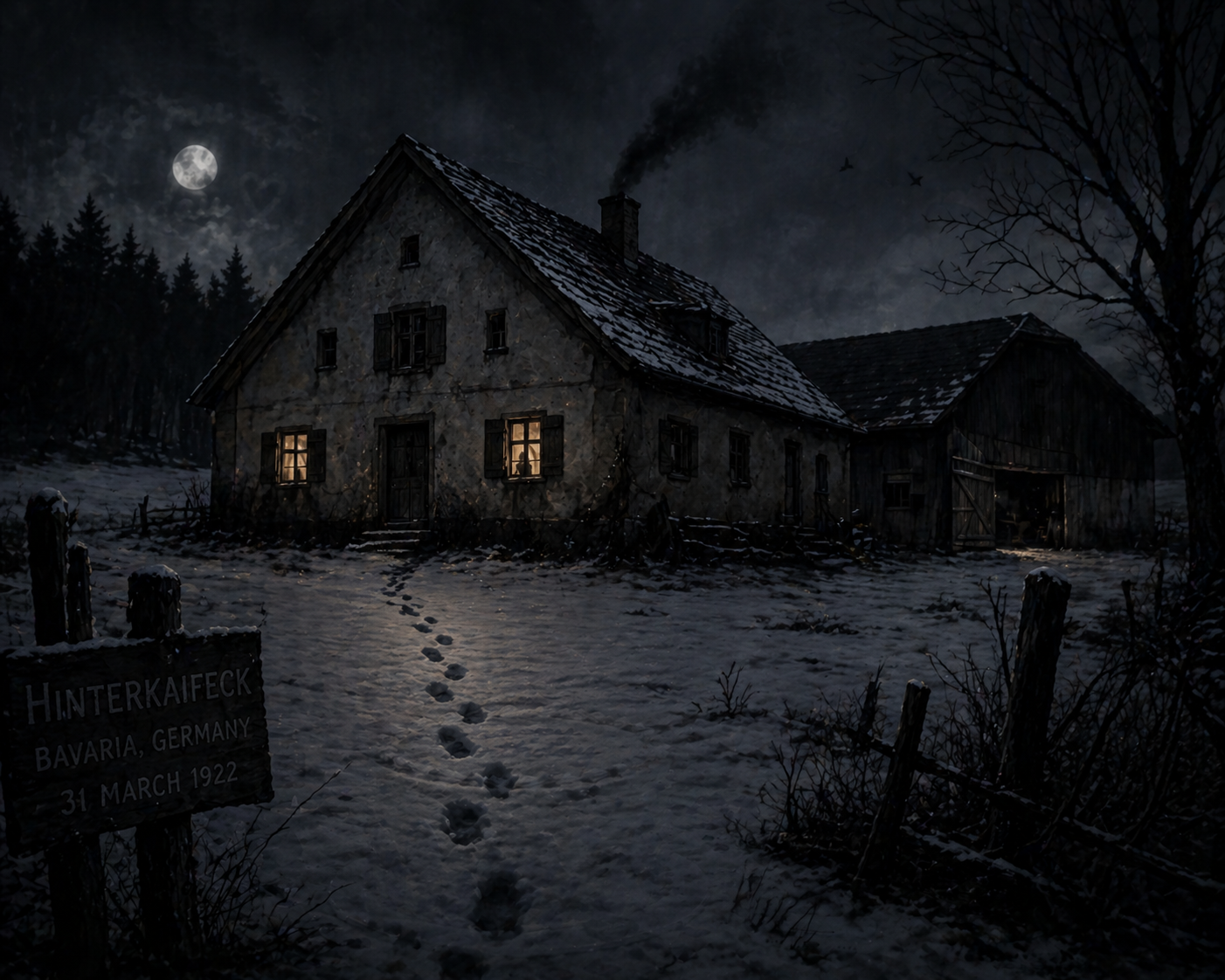
A Farm Where the Ending Didn’t End
You expect a crime to have a shape—beginning, escalation, end. The Hinterkaifeck murders refuse that shape. They read like something that starts before it starts and continues after it should be over.
Hinterkaifeck was an isolated farm in Bavaria. Six people lived there: Andreas and Cäzilia Gruber, their widowed daughter Viktoria, her two children, and a new maid who had just arrived. It was the kind of place where silence is normal—fields, distance, routine. The kind of place where anything unusual should stand out.
Something did.
Days before the murders, Andreas found footprints in the snow leading from the forest to the house. There were no footprints leading back. A set of steps that ended at the door and simply… stopped. Around the same time, there were sounds in the attic—movement overhead that didn’t belong to anyone in the house. The previous maid had already left, convinced the place was haunted. That word sounds dramatic until you realize it was the closest explanation available to someone who knew something was wrong but couldn’t prove it.
You don’t need anything supernatural here. You just need the possibility that someone was already inside.
Someone watching.
Someone learning.
Someone waiting.
On the night of 31 March 1922, the quiet breaks—but not loudly. One by one, members of the family are drawn into the barn. No alarms, no chaos spilling into the rest of the house. Just a sequence. Each person enters. None return.
They are killed with a mattock—a heavy farm tool. Close-range. Repetitive. There’s no distance in that kind of act. It requires control, proximity, and time.
Four bodies remain in the barn.
Inside the house, the pattern continues. A child in his crib. The maid in her room. Quieter deaths, but not separate ones. Part of the same order, the same plan.
This is where a crime is supposed to end—with escape.
It doesn’t.
For three days, someone stays in that house.
The animals are fed. The fire is kept going. Smoke rises from the chimney. From the outside, life appears to continue. There is no rush to disappear, no sign of panic, no urgency to get away from what has been done.
You can explain violence in a hundred ways—anger, revenge, calculation. Staying requires a different explanation. It suggests familiarity with the space, confidence in not being discovered, and a complete absence of fear.
The bodies are eventually found because absence becomes noticeable. The family doesn’t show up where they should. The routine breaks. Neighbours come looking. By then, the house has already held both life and death at the same time for days.
The investigation begins and never really finishes. Suspects are named, questioned, dismissed. Theories circle around the same gaps—motive unclear, timeline fractured, evidence compromised. No one is convicted. No explanation settles long enough to become truth.
The farm is later demolished, as if removing the structure might remove what happened inside it.
It doesn’t.
Because the part that remains isn’t the place. It’s the pattern.
You like to think danger announces itself—that it arrives with noise, disruption, something obvious enough to trigger a reaction. This doesn’t. This is quiet. This blends into routine. This exists alongside normal life long enough to become invisible.
By the time anything feels wrong, it isn’t new. It’s just finally visible.
That’s what this case leaves behind—not a solved crime, not a clean ending, but a possibility:
that sometimes, whatever ends a story
has already been there
long before the story begins.

Leave a Reply