
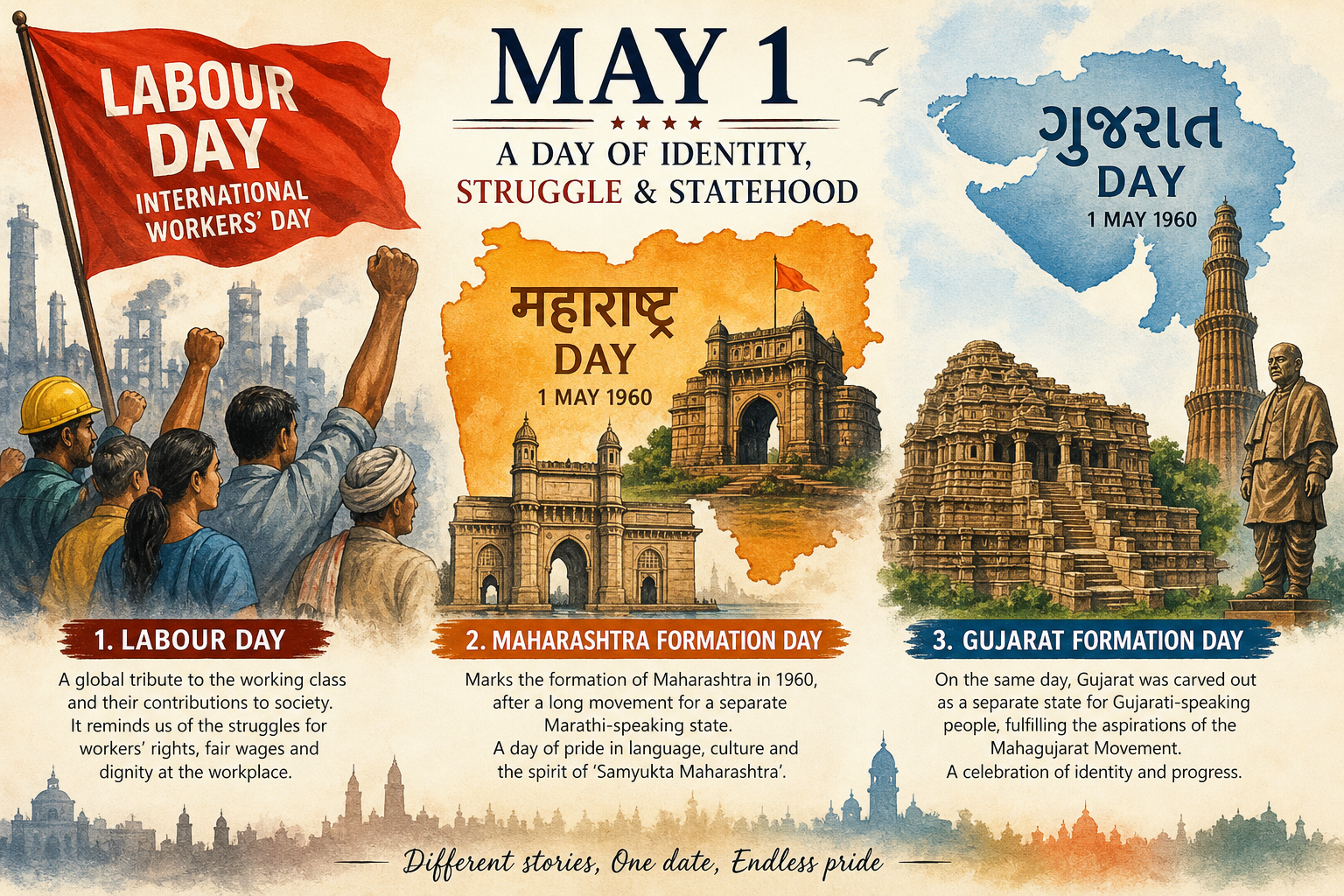
May 1: A Day of Identity, Struggle, and Statehood
Some dates don’t just sit quietly on a calendar—they carry history in their bones. May 1 is one of those days. Across the world and within India, it stands at the intersection of labour rights, cultural identity, and political reorganization. It is a day that celebrates workers, and simultaneously marks the birth of two states that redefined linguistic pride and regional autonomy.
Let’s unpack why May 1 matters.
1. : A Global Tribute to Workers
May 1 is most widely recognized as Labour Day (or International Workers’ Day), a tribute to the working class and their contributions to society. But behind the celebrations lies a history of protest, sacrifice, and relentless demand for dignity.
The origins of Labour Day trace back to the late 19th century, particularly the labour union movements in the United States. Workers were demanding an eight-hour workday—a concept that now feels basic, but at the time was revolutionary. The turning point came with the in Chicago in 1886, where a peaceful rally turned violent, leaving several dead. The event became a symbol of workers’ struggles worldwide.
In India, Labour Day was first celebrated in 1923 in Chennai, organized by the Labour Kisan Party. Today, it serves as a reminder of how far worker rights have come—and how much further they still need to go.
It’s not just about factory workers or daily wage earners. It’s about anyone who contributes effort, time, and skill—essentially, all of us. The day quietly asks: Are we valuing labour the way we should?
2. : The Birth of a Marathi Identity
For Maharashtra, May 1 is more than symbolic—it’s deeply personal. It marks the formation of the state in 1960, following a long and intense movement demanding a separate Marathi-speaking region.
Before 1960, the region was part of the bilingual Bombay State, which included both Marathi and Gujarati speakers. This arrangement led to growing dissatisfaction, especially among Marathi-speaking populations who felt culturally and politically sidelined.
The demand for a separate state intensified through the Samyukta Maharashtra Movement, a mass movement that saw protests, political negotiations, and even loss of lives. Eventually, on May 1, 1960, Maharashtra was officially formed with as its capital.
Today, Maharashtra Day is celebrated with parades, cultural programs, and official ceremonies. But beneath the celebration is a strong sense of linguistic pride and the idea that identity—when suppressed—will always find a way to assert itself.
3. : A Parallel Story of Statehood
Interestingly, the formation of Maharashtra also gave birth to another state—Gujarat. On the same day, May 1, 1960, Gujarat was carved out as a separate state for Gujarati-speaking people.
Much like Maharashtra, the demand for Gujarat emerged from linguistic and cultural aspirations. The Mahagujarat Movement led the charge, advocating for a state that would preserve and promote Gujarati identity.
The bifurcation of Bombay State into Maharashtra and Gujarat was a landmark moment in India’s post-independence history. It reinforced the idea that language could be a legitimate basis for administrative boundaries—a principle that shaped the reorganization of several Indian states.
Today, Gujarat Day is celebrated with equal enthusiasm, marked by cultural pride, public events, and reflection on the state’s journey since its formation.
One Date, Three Stories
What makes May 1 fascinating is how it weaves together three distinct narratives:
- A global fight for workers’ rights
- A regional assertion of Marathi identity
- A parallel rise of Gujarati statehood
At first glance, these seem unrelated. But look closer, and a pattern emerges—each is about people demanding recognition. Whether it’s workers asking for fair conditions or communities seeking cultural autonomy, May 1 is ultimately about voices refusing to stay unheard.
It’s a day that reminds us that change rarely arrives quietly. It is demanded, negotiated, and sometimes fought for.
And once achieved, it becomes history—marked forever on a calendar, waiting for someone to remember why it mattered.
If you think about it, May 1 isn’t just a date.
It’s proof that collective voices, when loud enough, can redraw maps—and rewrite rules.

Leave a Reply