
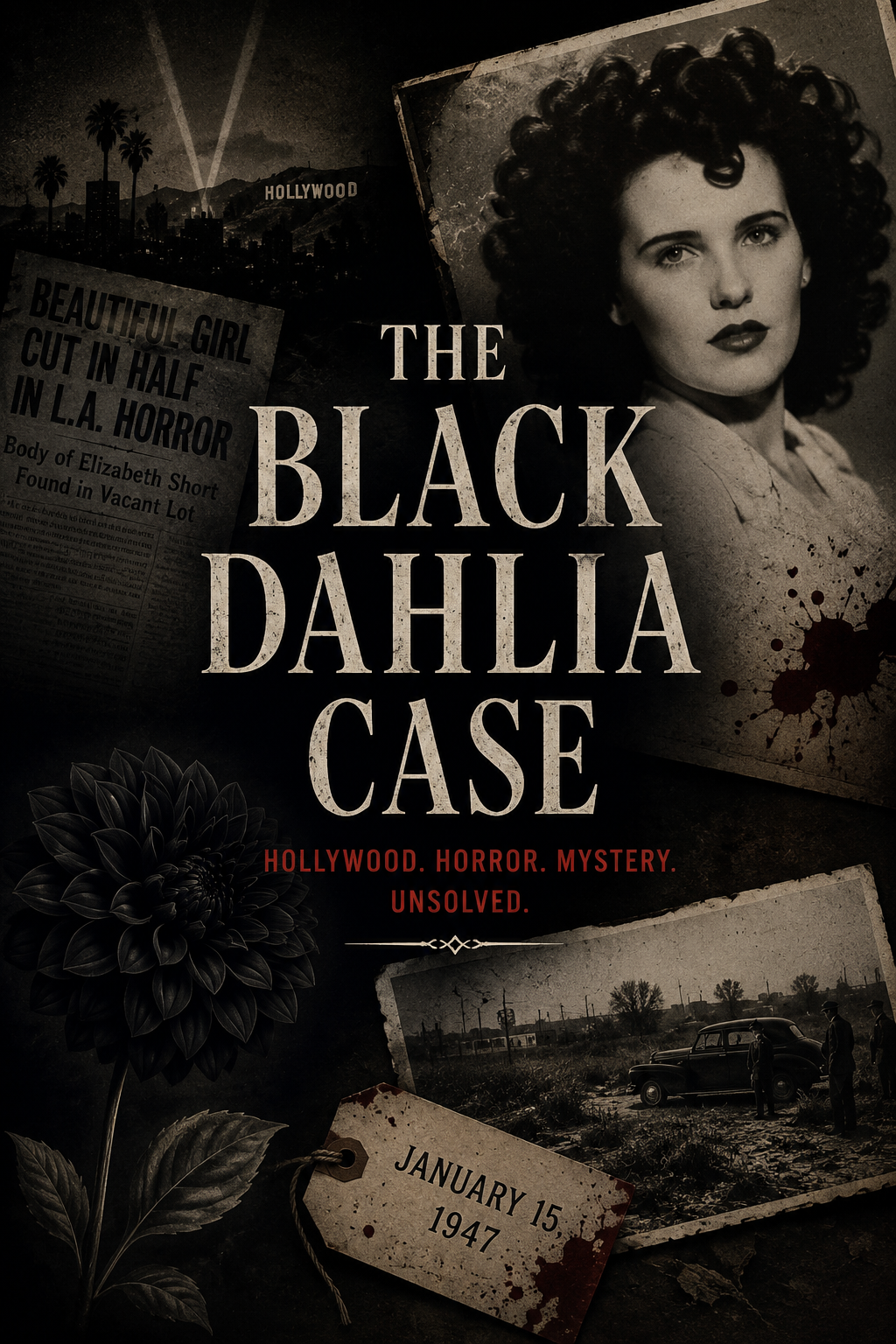
I won’t lie, I only googled this case because it was Wednesday Addams’ favorite unsolved murder mystery in the Netflix series Wednesday. In the scene where Thornhill gives Wednesday her welcome plant — a black dahlia — I immediately knew there had to be a real story behind it.
And very honestly, having read and watched enough true crime cases to become emotionally numb to humanity, I didn’t think this one would bother me. Or even feel worthy of being Wednesday’s favorite unsolved murder mystery.
But while I still believe the world has seen far more horrifying crimes, considering that this happened in 1947, I understand the choice.
Because the Black Dahlia case was not just a murder.
It was spectacle. Media frenzy. Hollywood noir. Misogyny. Mystery. Glamour. Violence.
And somehow, all of it fused together into one of the most iconic unsolved murder cases in history. Oh to live in a world where murder is glamorous 🤦🏻♀️.
Who Was Elizabeth Short?
Short answer? The victim.
Long answer?
Elizabeth Short was a 22-year-old woman born in Massachusetts in 1924. She had a really tough childhood. During the Great Depression, her father allegedly faked his own suicide and abandoned the family entirely (Men!). Needless to say, her mother struggled financially, and as a result, Elizabeth spent years moving from place to place.
As she grew older, she became fascinated with Hollywood glamour and the fantasy of reinvention. Like many young women of the era, she moved between Florida, Massachusetts, and eventually Los Angeles hoping for a better life.
And like most famous women in history — especially dead ones — the world became deeply obsessed with turning her into a character instead of a person.
The media spread countless rumors about her after her death. Some claimed she was an actress. Others insisted she was involved with organized crime. Some newspapers portrayed her as a sex worker, while others painted her as a dangerous femme fatale living a scandalous double life.
Most of these claims were exaggerated, unverified, or completely fabricated by tabloids trying to profit from her murder.
Friends described Elizabeth as flirtatious, stylish, ambitious, emotionally vulnerable, and constantly trying to reinvent herself. She often wore black clothing and sheer black outfits, which likely inspired the nickname “Black Dahlia,” possibly influenced by the noir film The Blue Dahlia.
So basically: a normal woman, navigating a world that would have found a reason to destroy her either way.
The Crime
On the morning of January 15, 1947, a woman walking with her child through Leimert Park in Los Angeles noticed what she thought was a discarded mannequin lying in a vacant lot.
God bless her soul, but that was NOT a mannequin.
It was Elizabeth Short.
Her dead body.
The scene horrified even seasoned detectives. Elizabeth’s body had been cut cleanly in half at the waist, completely drained of blood, washed by the killer, deliberately posed, and extensively mutilated. Her face had been slashed from the corners of her mouth toward her ears — a wound now commonly called a “Glasgow smile.”
Investigators believed the precision of it all suggested the killer had medical knowledge, surgical experience, or slaughterhouse training. The staging — the body placed just so, in a public lot, positioned to be found — pointed to planning, control, and a sadistic desire for an audience.
And from there, the investigation became an absolute circus almost immediately.
Hundreds of suspects. Fake witnesses. False confessions. Hoax letters. Media interference. Public hysteria, all colliding at once.
The LAPD reportedly received dozens of confessions from people who very clearly had nothing to do with the crime.
Which honestly raises one very important question: why are people like that?
At one point, over 150 suspects were considered seriously. No arrest was ever made.
The Mysterious Letters
Soon after the murder, newspapers began receiving packages supposedly sent by the killer — Elizabeth’s belongings, cut-out letters, handwritten notes, all cleaned with gasoline to remove fingerprints.
One note ended with:
“Here is Dahlia’s belongings. Letter to follow.”
Read that again. He sent her things back. Piece by piece. And then announced there was more coming.
The killer wasn’t hiding. He was performing. Many profilers later pointed to narcissism and a desperate hunger for notoriety — someone who needed the world to know what he had done, even if it could never know who he was.
The Suspects
George Hodel
George Hodel remains the most famous name attached to the case — and arguably the most credible. A doctor with surgical skills, he was allegedly abusive, deeply disturbing, and had his home secretly bugged by police in 1950. Recordings from that surveillance allegedly captured him saying:
“Supposin’ I did kill the Black Dahlia. They couldn’t prove it now.”
That sounds damning. The context surrounding it is still debated.
The most sustained accusation against Hodel came from his own son, former detective Steve Hodel, who wrote multiple books arguing his father was the killer. Many investigators remain unconvinced — but George Hodel is still considered the most plausible suspect the case ever produced.
Mark Hansen
Mark Hansen owned a nightclub and reportedly knew Elizabeth socially. She had stayed at properties connected to him, his name appeared in her address book, and he had allegedly pursued her romantically. The evidence, however, remained thin — and the theory never gained serious traction beyond circumstantial connections.
The case also briefly circled several others: a mortuary assistant named Leslie Dillon, who understood surgical mutilation and wrote unsettling letters about the case before the evidence collapsed; and various doctors proposed by independent researchers over the decades, each theory built more on speculation than proof.
None of it led anywhere.
Why The Case Was Probably Unsolvable From The Start
Many historians believe the investigation was doomed almost from the moment it began. Contaminated evidence. Witnesses intimidated or ignored. Rampant corruption concerns within the LAPD. A media so hungry for the story that they compromised the case at every turn.
The extreme mutilation also suggests the murder was deeply personal — not random — which points toward someone in Elizabeth’s social world. Someone known. Someone who slipped back into ordinary life while the circus raged around them.
Some investigators have argued Elizabeth may have been one victim in a pattern of unsolved Los Angeles murders from that era involving similar methods, raising the possibility of a serial killer. Others maintain the staging and rage point toward a singular obsession. Neither theory has ever been confirmed. Neither has ever been fully ruled out.
What The Case Actually Left Behind
The Black Dahlia case became a permanent part of American noir culture. It inspired books, films, documentaries, podcasts, conspiracy theories, and fictional detectives for decades. It also cemented the infamous “beautiful dead girl” trope in media — the idea that a woman’s death becomes most compelling when it can be aestheticized, mythologized, and consumed.
The media coverage surrounding Elizabeth’s murder was absolutely feral. Newspapers competed aggressively, sensationalized her life, fabricated stories, sexualized her, and transformed her into a gothic character for public entertainment. The nickname “Black Dahlia” became iconic almost immediately.
Some reporters even contacted Elizabeth’s mother pretending her daughter had won a beauty contest — only to reveal, after getting their reaction, that she had actually been murdered.
Yes. Actually. That happened.
The case became one of the first truly massive American media crime spectacles — the template for everything that came after it.
But honestly, that’s the tragedy of being a woman. Even in death, the world rarely allows us to remain human for very long.


Leave a Reply