
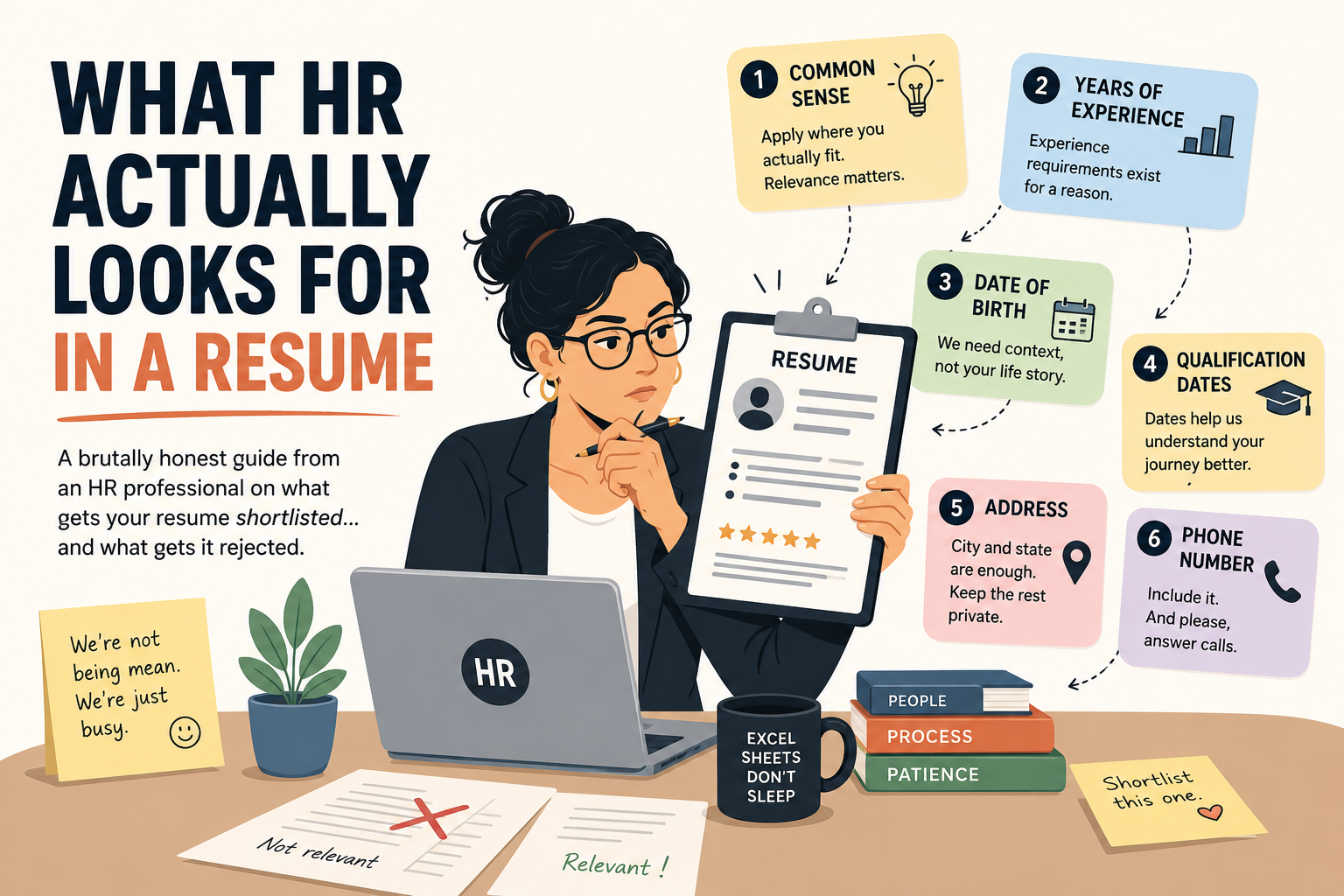
What HR Actually Looks for in a Resume
I work in HR, and over the years, I’ve gained a lot of insight into why a CV gets shortlisted, why it gets rejected, and why sometimes applicants never even hear back.
A lot of these reasons go beyond the job description, and yes, sometimes they may feel unfair from the candidate’s perspective. But from the recruiter’s side, they usually make perfect sense.
So here’s a brutally honest breakdown of what HR actually looks for in a resume.
1. The Rare “Common” Sense
As HR professionals, our job is not to fulfill your need for a job.
Our job is to find the right candidate for our job.
If you’re an English teacher applying to a cosmetic manufacturing company with no relevant or transferable experience, getting even an acknowledgement email should honestly count as an achievement.
And before people get offended — no, this does not mean career transitions are impossible. Transferable skills exist. But there’s a difference between a strategic transition and randomly applying to everything with an “Apply Now” button.
When recruiters go through hundreds of resumes for one role, relevance matters. A lot. We do not have the time, energy, or emotional stability to carefully analyze a math teacher’s CV for a core Procurement role.
Because realistically, if we open your CV and it has absolutely nothing to do with the role, we are not going to sit there admiring your optimism.
We are not going to be kind. Or even rational.
You will be made fun of. Brutally.
But in our defence, we are tired.
We have Excel sheets open.
2. Years of Experience Matter More Than You Think
We understand that some candidates genuinely have the skills to do a job despite having fewer years of experience than required.
And honestly? Sometimes we do consider that.
For a role requiring 7 years of experience, we may still evaluate someone with 5 or 6 years if the profile is exceptionally strong.
But if you are 3 years into your career and applying for roles requiring 7–10 years of experience, your resume will most likely get rejected before a human even views it.
Not because you are incapable.
Not because you are untalented.
But because hiring is also about risk, compensation structures, client expectations, reporting maturity, and organizational hierarchy.
Think of it this way: if a company offered you a ₹5,000 stipend for a full-time corporate role, would you accept it just because the brand could potentially “have potential”?
Probably not.
Because just like candidates expect fair compensation for their value, companies expect candidates to meet the experience requirements for theirs.
Sometimes your CV isn’t rejected because you’re bad.
It’s rejected because you’re simply too early.
3. Your Date of Birth Is Not There for Decoration
People often assume recruiters ask for date of birth because of ageism.
Most of the time, it’s much more practical than that.
We need context.
Someone may have only 2 years of post-MBA experience but already have 15 years of prior industry experience. Another candidate may technically qualify on paper but be just a few months away from retirement.
Different roles require different kinds of people.
Some positions need younger, highly energetic talent willing to work through chaotic changes and adapt quickly. Others need stability, maturity, and leadership experience.
Your age alone does not define your capability.
But it does help us understand where you may fit best.
4. Qualification Dates Tell Us More Than You Realize
“B.Com Graduate.”
Okay. But when?
Qualification dates help recruiters understand your educational journey better:
- Was the degree completed full-time or part-time?
- Was it online or on-campus?
- Was it done recently for career growth?
- Was it completed alongside work experience?
Without dates, your qualifications lose context.
And in hiring, context matters almost as much as credentials themselves.
5. Your Address Does Not Need to Include Your Dog’s Therapist
Recruiters do not need your:
- Flat number
- Building name
- Nearby landmark
- Blood group
- Or your dog’s preferred veterinary hospital
Your city and state are enough.
That’s it.
People seriously underestimate how much personal information they casually upload onto public platforms like LinkedIn and job portals.
I’m not saying a recruiter is going to show up outside your house with a bomb.
But why would you even leave that option available?
Protect your privacy.
Your resume is not an Aadhaar card.
6. Please Include a Phone Number. I’m Begging.
I cannot believe this needs to be said, but there are genuinely people applying for jobs without phone numbers on their resumes.
How exactly are recruiters supposed to contact you? Through telepathy?
And then there’s another category of candidates — the iPhone users who have enabled “Silence Unknown Callers.”
Amazing feature. Truly revolutionary.
Except… you’re job hunting.
Recruiters are probably going to call from unknown numbers. If every recruiter gets redirected straight to voicemail, eventually they stop trying.
Unless, of course, your long-term strategy is unemployment with aesthetic notifications.
Conclusion
The hiring process can feel cold, unfair, frustrating, and sometimes deeply impersonal. And honestly, sometimes it is.
But most recruiters are not sitting there plotting ways to ruin candidates’ lives. We are usually working against deadlines, pressure from hiring managers, compensation limits, Excel sheets from hell, and hundreds of applications for a single role.
A resume is not just a summary of your qualifications.
It is your first demonstration of judgment, professionalism, self-awareness, and attention to detail.
The truth is, a lot of candidates are rejected long before interviews because their resumes fail to answer one very basic question:
“Why should this person make sense for this role?”
If your CV answers that clearly, you’re already ahead of most applicants.

Leave a Reply