
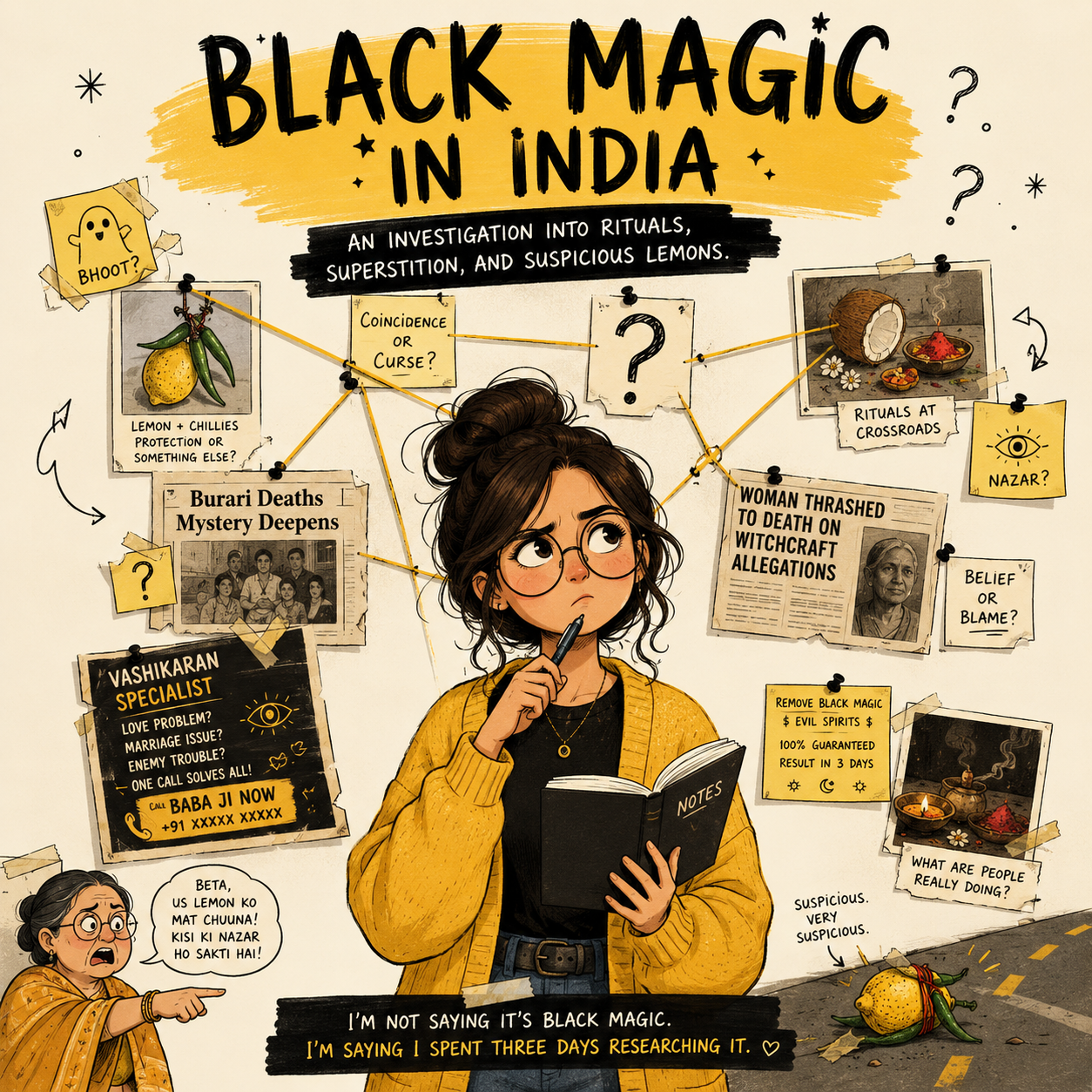
So… How Common Is Black Magic In India?
I was travelling back from work with a friend, discussing what I can’t remember right now, when he told me about an incident that occurred with him a while ago.
He and his wife were on a walk near their house when they saw a woman performing black magic.
Or so he thought.
As a good husband, that no man ever is, he knew if he went home and told his wife and mother — nobody would believe him.
So, he told his wife and made her see it too.
Men. 🙂
Anyway, they ran home and told his mother. I don’t remember what his mother said, but it got me thinking:
Is it really that common for black magic to happen in India?
For a couple to just witness it while on a leisurely evening stroll?
Which is why we will go down the rabbit hole.
The Thing Is…
If you’ve lived in India for more than seven minutes, you’ve probably encountered what looked suspiciously like black magic.
A lemon and seven chillies hanging outside a shop.
A coconut abandoned in the middle of a crossroads.
A pile of flowers, vermillion powder, an egg, and what appears to be the beginning of a murder mystery.
A grandmother urgently informing you not to touch a suspicious-looking lemon on the road because it belongs to somebody else’s curse.
India is full of things that look alarming when removed from context.
And black magic sits right at the intersection of religion, folklore, superstition, psychology, crime, and human imagination.
Which makes it very difficult to investigate.
Because the moment you ask whether black magic is real, everyone suddenly becomes an expert.
The problem is that nobody agrees on what black magic actually is.
What Are We Even Talking About?
Ask ten Indians what black magic means and you’ll receive eleven answers.
Some people mean curses.
Some mean possession.
Some mean evil eye.
Some mean ghosts.
Some mean a neighbour who somehow knows exactly when you’ve bought a new car.
Some mean a man named “Baba Ji” who has promised to reunite your ex with you within forty-eight hours.
The advertisements are honestly fascinating.
Lost love?
Business failure?
Court case?
Enemy troubling you?
Family dispute?
Exam stress?
Neighbour breathing too confidently?
Call now.
I have tremendous respect for the confidence.
Doctors won’t promise to fix every problem in your life.
Lawyers won’t promise to fix every problem in your life.
Yet somewhere above a medical store, a man with three WhatsApp numbers apparently can.
The Black Magic We Actually See
The funny thing is that most of what Indians identify as black magic isn’t necessarily black magic at all.
Many practices have religious, cultural, or folk origins.
Take the famous lemon-and-chilli charm.
Millions of businesses hang them outside their shops.
The belief is that they ward off bad luck or the evil eye.
Whether they work is another discussion entirely.
But the intention is protection.
Not harm.
Similarly, you’ll find people performing rituals involving coconuts, flowers, turmeric, vermillion, incense, and offerings at crossroads.
To an outsider, it can look deeply suspicious.
To the person performing it, it might simply be a prayer.
Which brings us back to my friend’s mystery woman.
What exactly was she doing?
Because unless she was standing in a graveyard at midnight shouting, “I AM CURRENTLY DOING BLACK MAGIC,” it is surprisingly difficult to tell.
The Problem With Eyewitnesses
One thing I’ve learned from reading far too much true crime is that eyewitnesses are terrible.
Not malicious.
Just human.
We see what we expect to see.
If you believe black magic is common, a woman performing an unusual ritual becomes a black magician.
If you don’t, she’s just a woman performing an unusual ritual.
The same event.
Two completely different interpretations.
And black magic stories often spread exactly like urban legends.
Someone saw something.
Someone else heard about it.
A cousin knew someone whose neighbour experienced it.
Before long, an entire locality is convinced a witch is operating near the water tank.
The Cases That Actually Make The News
This is where things become darker.
Because while evidence for supernatural black magic remains elusive, evidence for crimes committed in its name is everywhere.
And those crimes are very real.
People have been scammed out of enormous sums of money by self-proclaimed tantriks.
People have been convinced they are cursed and need expensive rituals.
Families have abandoned medical treatment because they believed a supernatural attack was responsible for an illness.
Entire communities have accused women of witchcraft.
Some have even killed them.
So Is Black Magic Common In India?
This depends entirely on what you mean.
Are black magic beliefs common?
Absolutely.
Extremely common.
Are black magic rituals common?
Probably.
Depending on how broadly you define them.
But is there evidence that supernatural forces are regularly being unleashed on unsuspecting citizens?
Not really.
What there is evidence for is something much more interesting.
Human beings have always struggled with uncertainty.
When something goes wrong, we want a reason.
A villain.
A curse.
An explanation.
Randomness is deeply unsatisfying.
A secret enemy performing black magic?
Now that’s a story.
And humans love stories.
Including me.
Which is why, instead of dismissing my friend’s mysterious woman outright, I choose to believe she gave me something far more valuable than evidence of black magic.
She gave me an excuse to spend several days researching one of the strangest rabbit holes in Indian culture.
And if she really was performing black magic?
Well.
At least it worked.
Because here we are.

Leave a Reply