
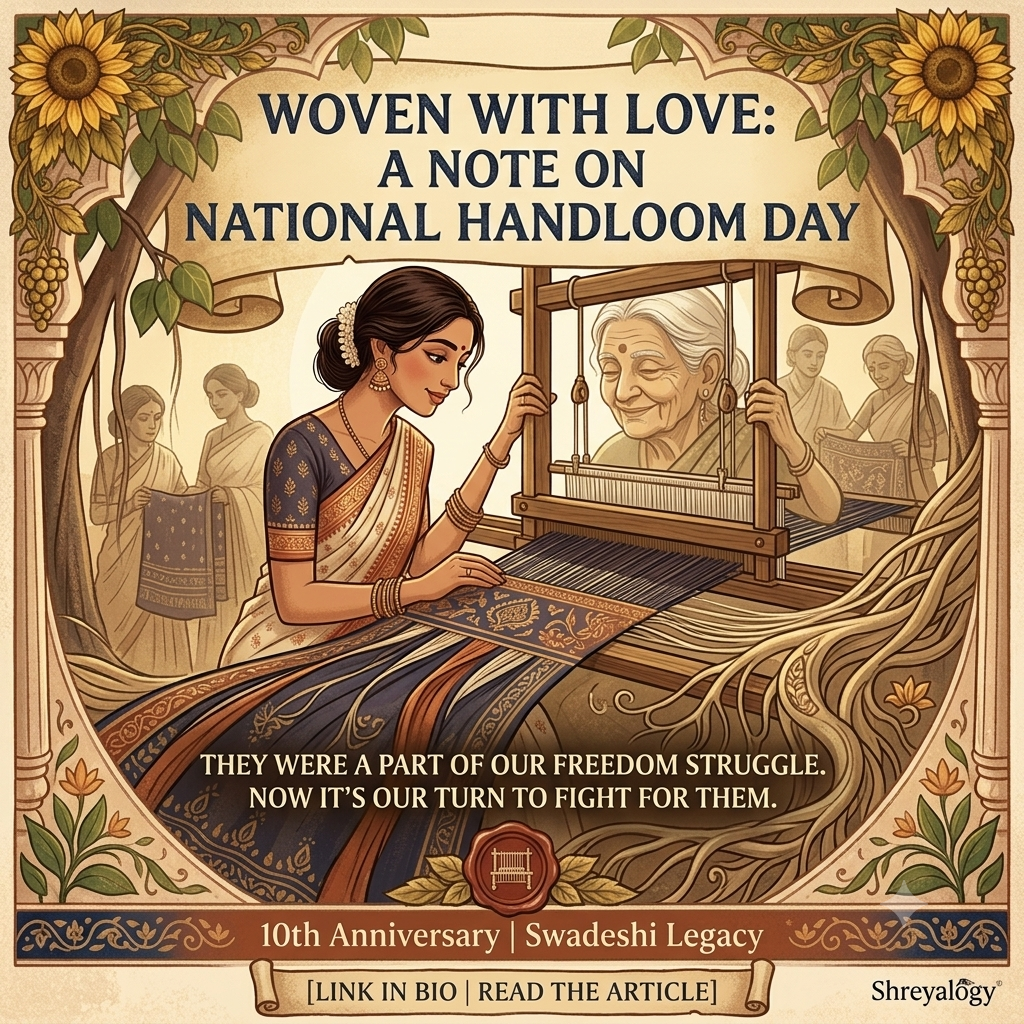

When I was a kid, my nani used to tell me stories from her childhood – about the things she had, the things she didn’t, and how she’d seen parts of her culture slowly get washed away by modernization. She told me how clothes were made in her time – by hand. Sarees, kurtis, dining table covers – every thread, every motif was handcrafted with care.
My mother has her own stories too. And sometimes, when she talks about them, I feel this unexplainable sense of loss inside me.
Of course, I’ve seen handloom products. But in our closets today, maybe one saree in a hundred pieces of clothing is handwoven.
Of course, I’ve seen how they’re made, but only through videos and photographs. I’ve seen handlooms as something that was an integral part of our culture. Was being the keyword here.
With modernization, we’ve not just lost the process, we’ve lost the soul. Each piece used to carry a story. It was imperfect. Not all lines were straight, not all flowers were complete, but it was made with intention, with love. It was personal.
Today, my clothes are made by machines. Machines that don’t have nicknames, don’t pause for a sip of chai, don’t sing while they work. And when you think about it like that… it’s just sad.
And I understand. I understand the need for modernization. I understand that the world’s most populated country cannot depend entirely on handlooms to clothe itself. It takes time, sometimes hundreds of hours to create just one piece. It takes effort. I get it.
What I don’t get is how we’ve let go of it entirely.
Why handloom isn’t considered a luxury in India, when it should be.
It’s made by people. Real, breathing, skilled artisans who are trying to protect what’s left of our artistic heritage.
Handlooms weren’t just textiles, they were part of our rebellion. On this very day in 1905, the Swadeshi Movement was launched to protest against the British Raj in India. It promoted indigenous industries, especially handlooms, as a form of economic resistance. That’s why, in 2015, this day was officially declared National Handloom Day by the Government of India.
But I believe it deserves more than a day.
The industry deserves more than remembrance.
It deserves to remain relevant.
School field trips should visit handloom clusters, so children can see how fabric was once made, not just worn. I hope I get to witness it myself someday. Maybe even try it, to feel the rhythm, the patience, the tradition woven into every inch.
So on this 10th Anniversary of National Handloom Day, I urge India to pause and look at what we’ve lost, and what we’re still losing. Let’s come up with real solutions to preserve what’s left of our craft, our culture, our legacy.
Wishing everyone a very happy National Handloom Day.
They were a part of our freedom struggle, now it’s our turn to fight for them.

Leave a Reply