
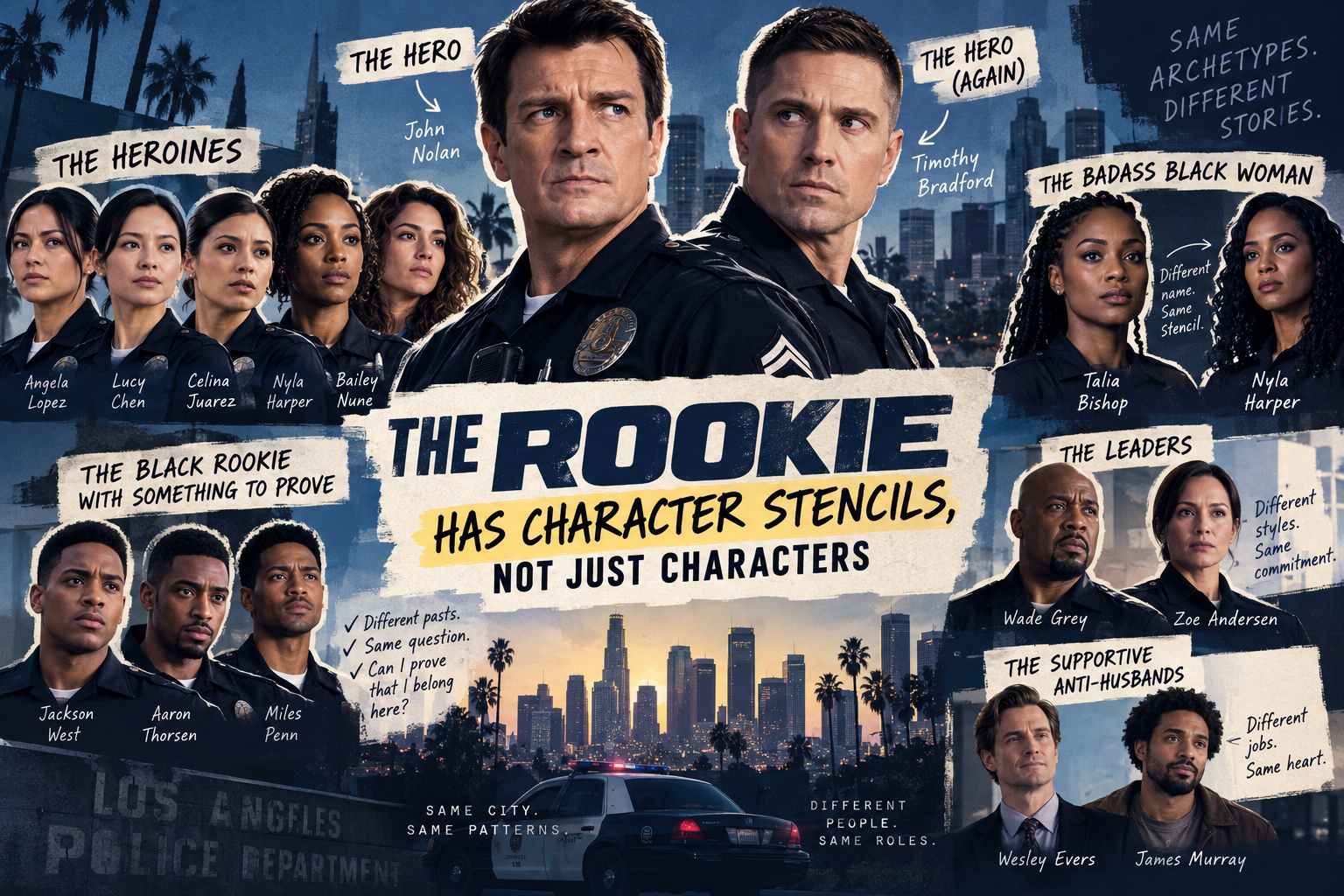
The Rookie Has Character Templates, Not Just Characters
I’ve spent the last few days watching The Rookie, and I’ve come to a rather strange conclusion.
I don’t think The Rookie has as many different character archetypes as it appears to have characters.
The more I watch, the more I notice that many of its characters seem to fit into very specific prototypes. The names, backstories and personalities change, but the underlying role stays remarkably consistent.
Sometimes the similarities are subtle.
Sometimes they’re so obvious that I start wondering whether the writers have a character stencil sitting somewhere in the writers’ room.
So, here are some of the Rookie prototypes I’ve noticed.
1. The Heroes
There are two of these: John Nolan and Timothy Bradford.
And I suspect Tim Bradford would absolutely hate being compared to John Nolan.
But underneath their wildly different personalities, these two have quite a lot in common.
They’re both righteous to a fault. They’re both competitive. They’re both exceptionally stubborn. And they both have a rather pronounced case of what I can only describe as Hero Syndrome.
Neither of them is particularly good at standing around while someone else deals with a problem.
If something is wrong, they want to fix it.
If someone is in danger, they want to save them.
If an injustice is happening, they want to personally do something about it.
Their methods are completely different, of course.
Nolan approaches problems with optimism, empathy and a belief that there is usually another way.
Bradford approaches them with the energy of a man who has already identified the correct way and would like everyone else to stop wasting his time.
But morally, they’re surprisingly similar.
They’re both deeply invested in doing the right thing, even when doing the right thing is inconvenient, dangerous or professionally disastrous.
They’re also both spectacularly bad at being emotionally vulnerable.
Bradford’s version of affection is essentially:
“I don’t care about you.”
Immediately risks his life for you.
Nolan’s version is:
“I understand what you’re going through.”
Immediately inserts himself into the situation.
And, in a completely unrelated observation, both of these men have dated Lucy Chen.
Which is particularly funny when you step back and look at the pattern.
Lucy Chen apparently has a type.
And that type is morally intense men with authority issues.
2. The Heroines
If the men of The Rookie are allowed to be heroes, the women are allowed to be something even more interesting:
Badass.
There are a lot of exceptionally capable women in this show, and I’d argue that almost every woman in the police force could fall somewhere under the broad “heroine” category.
- Angela Lopez is badass.
- Nyla Harper is badass.
- Celina Juarez is badass.
- Lucy Chen is badass.
- Talia Bishop was badass.
- Bailey Nune is badass.
And there’s something interesting about the demographic pattern here.
The show’s heroic female characters are overwhelmingly women of colour.
Angela, Celina and Jessica are Latina. Chen is Chinese-American. Talia and Nyla are Black women. Bailey is mixed.
Meanwhile, the show’s white female characters have much more frequently occupied antagonistic or morally questionable roles.
I don’t think it’s necessarily fair to declare that this is some deliberate master plan by the writers. Television casting is complicated, and there are plenty of exceptions.
But as a recurring pattern, it’s noticeable.
Especially because the show doesn’t just have one particular type of badass woman.
It repeatedly seems to return to the same template.
Which brings me to one of the strangest examples.
3. The Badass Black Woman
Talia Bishop and Nyla Harper.
Not at the same time, obviously.
When Talia’s actor left the show, the series eventually introduced Nyla — another Black woman who is exceptionally competent, tough, emotionally guarded and carrying a complicated past.
The characters aren’t identical.
But structurally?
They’re remarkably similar.
It’s almost as if the show had a vacant position labelled:
BADASS BLACK WOMAN WITH A TWISTED PAST
and simply needed to fill it.
This is one of the things that makes The Rookie fascinating to me.
Television shows don’t just create characters.
They create narrative functions.
A character leaves, but the story still needs someone to occupy the same function. So another character comes along who may have a different personality and different history, but performs essentially the same job within the story.
Talia leaves.
The slot remains.
Nyla arrives.
And suddenly the stencil has been filled again.
And this isn’t the only time the show does something like this.
4. The Black Rookie With Something to Prove
Jackson West. Aaron Thorsen. Miles Penn.
Three very different men.
Three very different stories.
And yet, when you strip away the details, they’re all variations on the same emotional premise:
I need to prove myself.
Jackson
Jackson is a nepo-kid whose father is a prominent LAPD officer. His entire life has been shaped by his desire to impress his father and prove that he belongs in the profession.
Aaron
Aaron is an ex-convict who was falsely convicted. Joining the LAPD becomes part of his attempt to rebuild his life and prove that he is more than the worst thing that happened to him.
Miles
Miles was an aspiring football player whose career was destroyed after a serious knee injury. The LAPD becomes his new career — and another opportunity to prove himself after losing the identity he’d built his life around.
The circumstances are different.
The wound is different.
But the underlying question is the same:
“Can I prove that I belong here?”
And that’s actually a more interesting recurring theme than simply saying the show keeps introducing similar characters.
Jackson is trying to escape his father’s shadow.
Aaron is trying to escape his past.
Miles is trying to escape the future he thought he was going to have.
All three are placed into the same institutional environment and asked, in different ways, to establish their legitimacy.
It’s the same character architecture with different foundations.
5. The Leaders
Then there are Wade Grey and Captain Zoe Andersen.
These two have fewer obvious similarities.
In fact, personality-wise, they’re quite different.
But they share a very particular conception of leadership.
Neither is the kind of commander who is content to sit safely behind a desk while everyone else is in danger.
Both are willing to put themselves in the line of fire.
Both are brave.
Both are fiercely protective of the people under their command.
And both can be extraordinarily strict, including with people they genuinely care about.
There’s an important distinction between being a boss and being a leader in The Rookie.
Grey and Anderson are willing to accept the risks that come with asking other people to take risks.
They don’t merely give orders.
They show up.
Their leadership styles differ, but the underlying principle is remarkably similar:
If my people are going into danger, I am going with them.
6. The Supportive Anti-Husbands
And now we arrive at the category that made me stop and stare at the television.
Wesley Evers and James Murray are literally the same person.
Okay, not literally.
But hear me out.
Wesley begins as a defense attorney who has plenty of problems with the LAPD and the way police officers operate.
James is a community organiser who also has significant problems with the police and the institution they represent.
Both are initially positioned as outsiders who have legitimate reasons to distrust the system their eventual wives work within.
Then they meet their respective women.
And slowly, the hostility gets complicated.
They don’t suddenly decide that everything the police do is wonderful.
Instead, they gain a personal understanding of the people on the other side.
They see the individual human beings inside the institution.
And eventually, both become extraordinarily supportive husbands.
They’re essentially the show’s anti-police-system-but-very-much-pro-wife husbands.
And honestly?
They’re both green forests.
But I still think Wesley is the better one.
Sorry, James.
Wesley has the advantage of being the original model.
The Bigger Pattern
And this is what I find most interesting about The Rookie.
I don’t think the show necessarily has a problem with repetitive characters.
I think it has a small collection of narrative prototypes that it repeatedly remixes.
- The righteous hero
- The badass female cop
- The badass Black woman with a complicated past
- The Black rookie trying to prove himself
- The strict but protective leader
- The civilian ideological counterweight who becomes a supportive partner
The details change.
The actors change.
The relationships change.
The backstories change.
But the underlying machinery remains remarkably consistent.
And perhaps that’s why The Rookie feels like it has such a large ensemble while still being strangely easy to categorise.
It’s not necessarily giving us entirely new archetypes every time.
It’s taking familiar ones and asking:
What happens if we change the backstory?
What if the rookie is the son of a cop?
What if he’s an ex-convict?
What if he lost his dream career?
What if the badass Black woman is Talia?
What if she’s Nyla?
What if the civilian who challenges the police is a defense attorney?
What if he’s a community organiser?
The show keeps changing the pieces while keeping some of the underlying shapes intact.
And once you start noticing those shapes, it’s almost impossible to stop.
Now I watch The Rookie and instead of thinking:
“Oh, here’s a new character.”
I find myself thinking:
“Oh. I know which prototype this one is.”

Leave a Reply