
Indians once relied on Ayurveda and home remedies like turmeric milk. So why did we stop trusting our own traditional medicine? A personal reflection.

We Are Sleeping on Our Own History
I think one of the things Indians sleep on the most is their own history and culture.
Our ancestors believed in, practiced, and perfected countless things that we either don’t understand anymore or don’t care enough to explore. And when I say we, I mean me included.
So this is a new series where I consciously try to rediscover Indian practices we’ve forgotten and question why they quietly disappeared from our daily lives. We’re starting with health and medicine.
I grew up in India, in a very Indian family. And if there is one thing you should know about Indian families, it’s that we have a lot in common with Latinos. In the highly relatable words of Gloria Delgado-Pritchett,
“In Colombia, you can’t go to the doctor for every little sniffle or dislocated shoulder.”
Same rules apply here. Going to the doctor is only for the big dawgs. You have cancer? We need a doctor. You have a flu? Nope. Don’t be weak, you’re not a baby.

Why Indians Avoid Medicines
In Indian households, falling sick is seen as a personal failure. Taking medicine makes it worse. At that point, you might as well identify as a baby. Eye roll.
The popular assumption is that Indians avoid doctors because of money or a weak healthcare system. While that is true for some, it is not the whole story. There is a cultural reason behind this reluctance.
Historically, Indians were taught that the body should be strong enough to heal itself. Medicines were seen as a last resort, not a lifestyle. You only interfered when absolutely necessary.
And then there’s pride. Indians feel proud for not needing help, medical or not. We rarely take sick leaves – it’s a matter of pride to be hardworking and invincible.
This mindset still lingers, even if we no longer fully understand where it came from. The newer generations of course don’t fully fall in this category, but we are not here to talk about them.

India’s History With Ayurveda and Home Remedies
Long before modern medicine existed, India already had a fully developed medical system. Ayurveda was not an alternative practice. It was the primary one.
We had kadhas, buttis, herbal oils, and home remedies passed down through generations. These were not random hacks. They were structured, intentional, and deeply connected to daily life.
Food was medicine. Routine was medicine. Prevention mattered more than cure.
Our ancestors did not pop pills at the first sign of discomfort because they did not need to. Their lifestyle itself was designed to keep the body resilient.

What Is Golden Milk and Why It Works
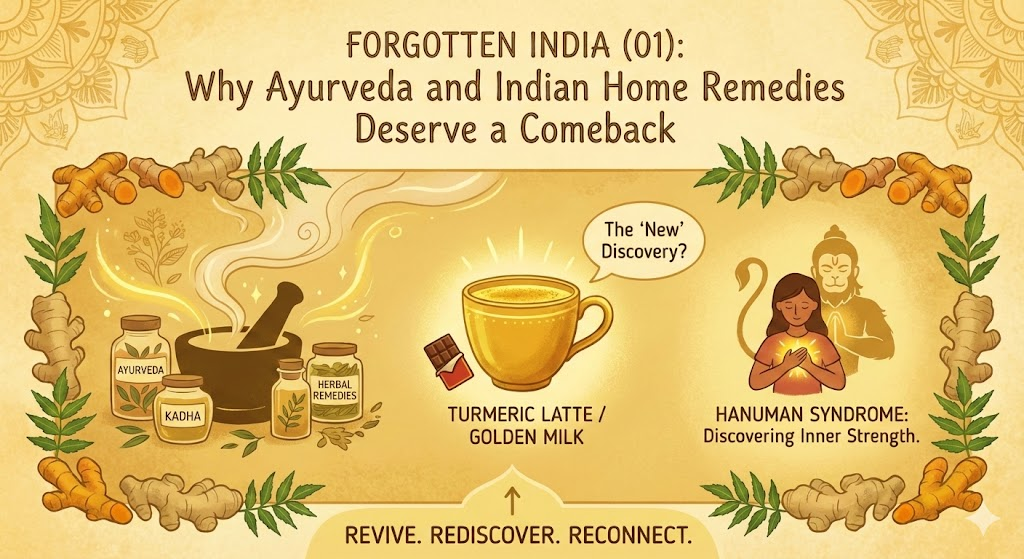
One such remedy that has recently been rediscovered by the West is what they now call Golden Milk or Turmeric Latte.
As an Indian, let us take a moment of silence. Because why do you take something from our culture, rename it, and sell it back to the public like it’s a new invention.
Turmeric milk has existed in Indian households for centuries. Millenniums even. It was given for colds, inflammation, internal healing, and immunity. Turmeric is a natural anti-inflammatory and antibacterial ingredient, and milk acts as a carrier that helps the body absorb it better.
This was not a trend. It was common sense.

Turmeric Milk for Cold and Flu
A few weeks before the New Year, I felt the familiar signs of falling sick. A slight ache in my throat. A runny nose, not congestion, just water dripping constantly.
This is the symptom. The one that tells you your Christmas and New Year are about to be ruined by a flu.
I told my mother, and she suggested homeopathy. I refused. Homeopathy takes time, and New Year’s was six days away.
That night was miserable. I could barely breathe.
The next morning, I asked for something hot. My mother suggested chocolate milk. I agreed, then asked her to add turmeric to it.
It sounds horrible if you have never tried it. But it is good. Tastes exactly like chocolate milk.
Within an hour, my nose stopped running. My throat felt normal. I drank another glass that night. By the next morning, I was completely fine.
A few days later, on December 31, I inhaled a dangerous amount of dust while cleaning my room. The symptoms returned instantly. Panic followed. We were six hours away from 2026.
That night, I drank two glasses of turmeric chocolate milk back to back. I was made fun of by my mother and younger brother. But by midnight, I was perfectly healthy.

Why We Stopped Trusting Our Own Traditions
That experience made me realise something uncomfortable.
The short answer is that our traditions are not glamorous. In today’s world, what sells is what looks aspirational. People will proudly Instagram their green smoothie but will never do the same for haldi doodh. Not because it does not work, but because we have not tagged it as cool yet. The West did that branding before we could, and once it became aesthetic and marketable, we were suddenly ready to accept it again.
Somewhere along the way, we decided that Western validation mattered more than our own lived knowledge. We abandoned prevention for quick fixes. We replaced wisdom with branding.
We, as Indians, have serious Hanuman syndrome. We do not know who we are. We have forgotten the power that already exists within our culture.
And the worst part is that the remedies still work. We just stopped believing in them.
This series is my attempt to remember. And maybe, in the process, remind others too.

Leave a Reply