
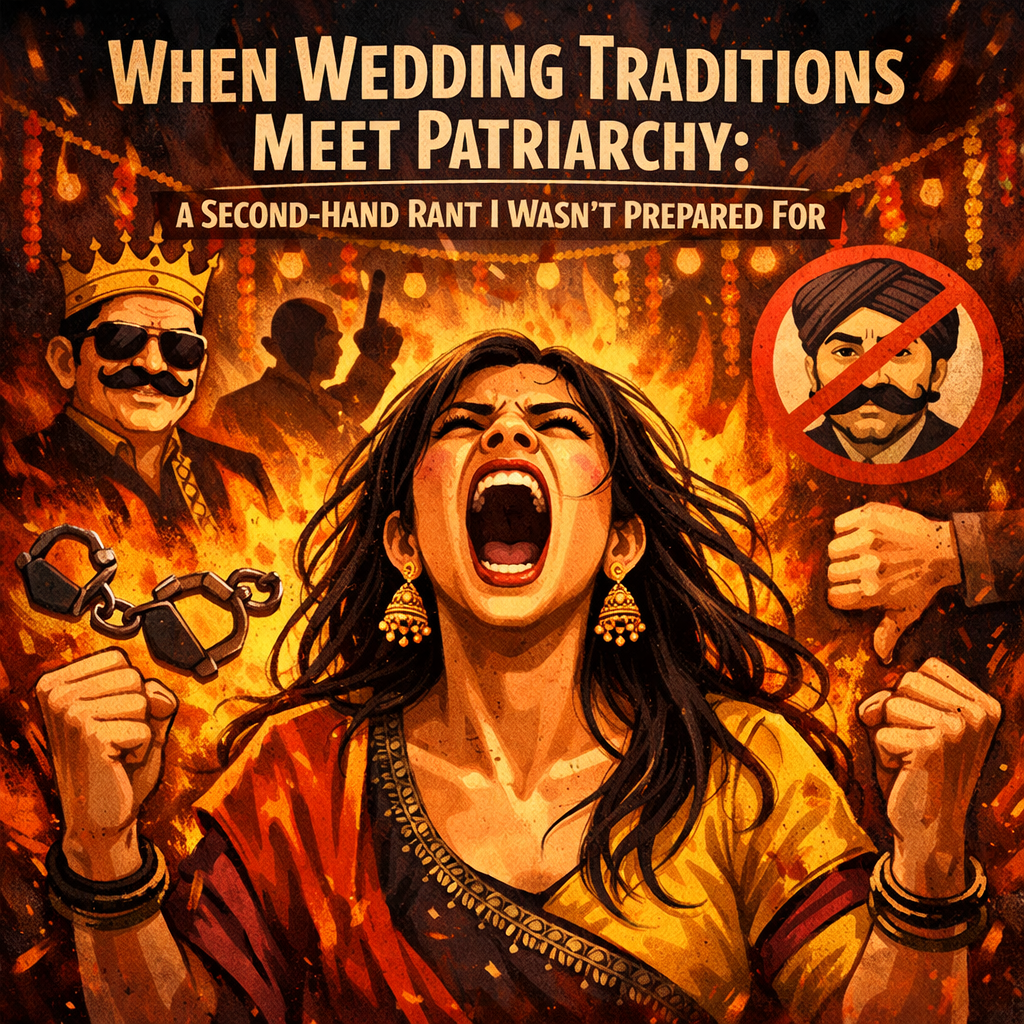
I didn’t even attend the wedding.
That’s the best part.
I had just come back from work and was done with my snacks. I chose to skip dinner but I wanted to sit with my parents while they had theirs. So I did. I was just existing near them at the dining table when my mother, who came back from my cousin’s wedding a few days ago, began narrating Events — the way Indian mothers do, with full emotional investment, dramatic pauses, and the implicit expectation that you will immediately take the correct emotional side.
So apparently, there’s this North Indian wedding tradition where women from the bride’s side hurl abuses at the groom’s family. Proper, loud, theatrical abuses. Everyone laughs. Nobody fights. It’s supposed to be playful. Cultural. Traditional.
I don’t fully understand it, but fine. Every community has that one ritual where chaos is officially sanctioned for entertainment.
According to my mother, some daughters-in-law were performing this tradition with tremendous dedication. Volume high. Confidence unmatched. Zero hesitation. The kind of energy people usually reserve for political debates or traffic fights.
Now somewhere along the way, the insults apparently expanded beyond the groom’s family and started including ours too. Not playful teasing anymore. Just people getting increasingly comfortable saying things they absolutely wouldn’t dare say outside the magical legal protection of “shaadi ka mahol hai.”
My mother didn’t like that. And honestly, neither did I.
So while listening, I was completely on my mother’s side.
Yes, that sounds annoying. Yes, tradition is not a free pass to disrespect people. Yes, weddings should not double as verbal combat arenas.
I was emotionally aligned. Rational. Supportive. Ready to condemn rude relatives.
And then she said:
“They were saying all this in front of men.”
And she went on to repeat it several times in different words, centred around being disrespectful while MEN were in the audience.
I’m sorry — what?
That’s the issue?
Not the abuses themselves. Not people crossing boundaries. Not basic respect evaporating mid-function.
The problem is that men were present?
So abuses are acceptable — culturally enriching, even — as long as they occur in a women-only environment? But the moment men hear them, suddenly civilisation collapses?
And just like that, my brain exited the conversation.
Because now the argument wasn’t about behaviour anymore. It became about women needing to maintain dignity in front of men. As if morality activates only under male observation. As if men are some kind of societal quality-control department monitoring acceptable female expression.
I wasn’t even at this wedding and suddenly patriarchy logged into my living room without permission.
Now I’m stuck in the most frustrating position imaginable:
I still think abusing people — tradition or not — is wrong.
But I refuse to agree that the scandal lies in women doing it in front of men.
Which means I somehow end up sounding like I’m defending the abusive side simply because I will not endorse patriarchal reasoning.
How does this keep happening?
How does every single issue take a sharp detour into gender policing?
Why the fucking fuck are all issues in India routed through patriarchy 😭
Why can’t the conclusion just be: “Maybe don’t insult people.”
Why must it become: “Women shouldn’t behave like that when men are around.”
I didn’t go to the wedding. I didn’t hear a single abuse. I only received second-hand narration.
And yet here I am, emotionally involved, philosophically exhausted, and irrationally angry at an entire social mindset.
I started this conversation annoyed at rude relatives.
I ended it questioning why respect in this country still seems audience-dependent.
And honestly?
AHHHHHHHHHHHHHHHHHHHHHHH
I WANT TO PUNCH SOMEONE.

Leave a Reply