
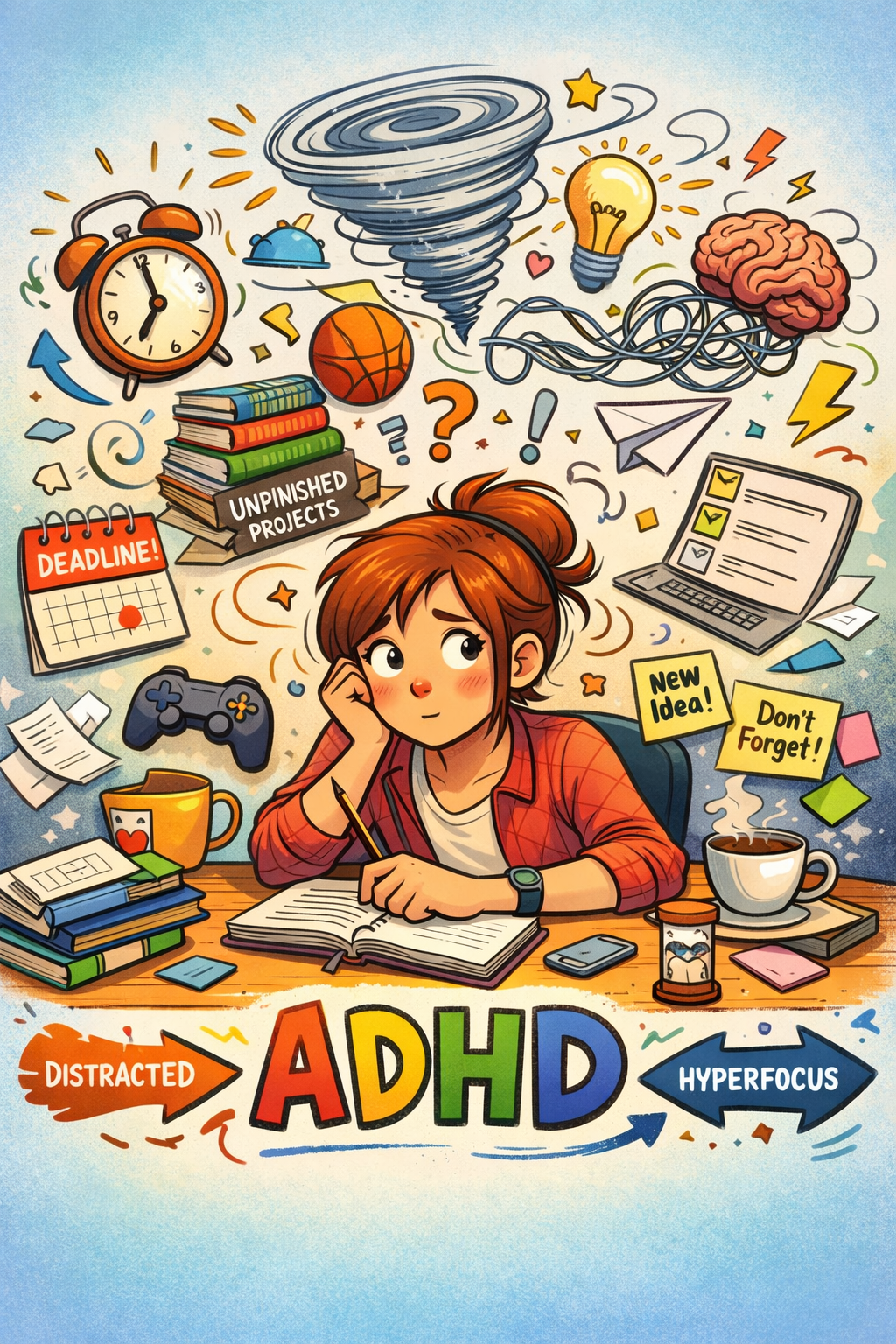
Attention Deficit Hyperactivity Disorder (ADHD) is often misunderstood. Many people assume it simply means someone is easily distracted or hyperactive. In reality, ADHD is more about how the brain regulates attention, motivation, and impulses.
People with ADHD do not necessarily lack focus. Instead, their attention tends to be inconsistent. They may struggle to start certain tasks while being able to concentrate intensely on others.
(The internet usually treats ADHD either as a tragedy or as a quirky personality trait. Officially it is a neurological condition. Unofficially… I do think it can come with some quirky personality traits. But that’s just my opinion.)
Below are some commonly discussed ADHD traits and why they make some people begin to wonder whether they might have it.
Difficulty Starting Routine Tasks
Many people with ADHD report that beginning routine or repetitive tasks can feel unusually difficult. Even when they know something is important, the brain seems reluctant to start.
For example, instead of doing homework regularly, someone might develop a system where they complete months of homework the night before the teacher checks notebooks. Not the week before. Not even the day before. The night before.
And this kind of last-minute sprint somehow still works.
Hyperfocus on Interesting Tasks
ADHD is often misunderstood as an inability to focus, but the opposite can also happen. When something feels interesting or stimulating, people can enter a state of extremely deep concentration known as hyperfocus.
In these moments, time disappears. Hours pass quickly and a large amount of work can be completed in one sitting.
For instance, someone might sit down to write a little and end up producing sixteen chapters in a single burst of writing because the idea refuses to leave their mind.
And this is exactly why I sometimes start wondering if I might have ADHD.
Too Many Ideas at Once
Another commonly reported experience is having a constant flow of ideas. Starting new projects can feel exciting and easy.
The challenge is that the brain keeps generating new and interesting concepts, which makes it harder to stay focused on finishing older ones.
This can lead to situations where someone ends up with dozens of unfinished projects, not because they lack interest, but because their mind keeps discovering new directions it wants to explore.
Hyperactive Thinking
Many people with ADHD describe their minds as constantly active. Thoughts, questions, and observations appear continuously.
Something ordinary can quickly turn into a complex chain of ideas.
For example, someone might look at something as simple as a bus curtain and immediately begin thinking about a hypothetical crime scenario involving long-term exposure to poison through that curtain.
When the brain naturally turns everyday observations into elaborate scenarios or ideas, it can make a person pause and think.
And again, this is exactly the kind of thing that makes me wonder whether ADHD might be involved.
Spotting Patterns and Inconsistencies
People with ADHD traits often notice patterns, loopholes, and inconsistencies quickly.
While this can be useful in problem solving, it can also make it difficult to watch movies or crime shows without mentally analyzing the plot.
Instead of simply watching the story, the brain may start asking questions like:
- That murder method wouldn’t work.
- That suspect has no motive.
- Why didn’t the investigators check that earlier?
After noticing several of these patterns in everyday life, some people naturally begin asking themselves a question:
What if this is actually ADHD?
The Importance of Proper Diagnosis
Of course, recognizing a few traits does not mean someone definitely has ADHD. Only a trained mental health professional can diagnose it.
However, learning about these patterns can help people understand how their brains work and decide whether seeking professional guidance might be useful.
Understanding ADHD is not about labeling people. It is about recognizing that different brains may process attention, motivation, and ideas in different ways.
And sometimes, that understanding is the first step toward learning how to work with the brain instead of constantly fighting against it.

Leave a Reply