
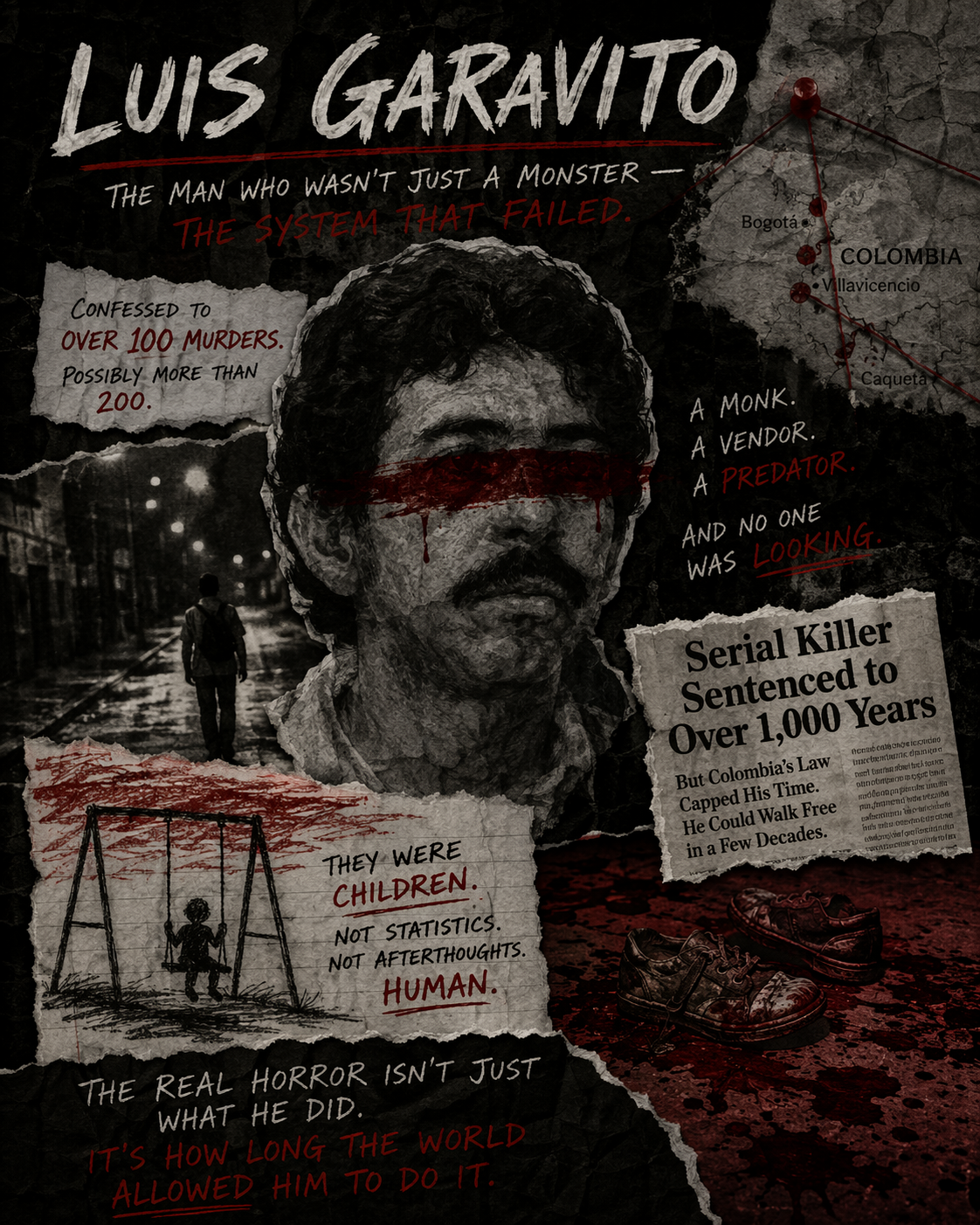
Let’s get one thing straight. I have a type.
I like learning about crimes and I absolutely love serial killer stories because there’s absolutely no explanation for them. Not from science, and definitely not from God. Serial killers really just walk in and destroy the world’s biggest belief systems by simply existing.
And for this love, I was on Wikipedia. And the page says this guy called Luis Garavito is the serial killer with the highest number of victims.
Interesting.
Why the Luis Garavito Serial Killer Case Is More Than Just a “Monster” Story
Calling Luis Garavito “a monster” is convenient. It wraps everything up in a neat little box labeled evil and lets the world move on.
But monsters don’t walk freely across cities for seven years.
Systems let them.
And honestly, I’d appreciate it if we started blaming a little more than just the villain of the story for the crimes they commit.
How Luis Garavito Operated in Plain Sight for Years
Because Luis Garavito didn’t hunt in shadows. He walked in broad daylight. For years.
He dressed like someone harmless. A monk. A street vendor. A teacher. Sometimes just another forgettable man standing in a crowded place.
And that’s the thing — he didn’t need to hide.
No one was looking.
His victims were children the world had already decided not to look at too closely.
Poor.
Working-class.
Homeless.
Or just… invisible enough.
Easy to miss.
Easier to forget.
Perfect victims — not because they were weak, but because the system around them was.
Luis Garavito Victims: Why Vulnerable Children Were Targeted
We like to believe that crime gets solved because justice is inevitable.
At least that’s what we’ve been taught.
It’s not.
Crime gets solved when someone important disappears.
When someone loud disappears.
When someone visible disappears.
But Garavito’s victims didn’t create noise.
They created silence.
Many of them came from backgrounds where reporting wasn’t immediate, records weren’t strong, and urgency simply didn’t exist in the same way.
And that silence?
That’s where he operated.
The Pattern Behind the Luis Garavito Murders
What makes this case worse is that it wasn’t chaos. It was pattern.
He didn’t just attack children. He approached them.
Bus stops. Markets. Streets. Public places. Daylight.
He would talk to them. Offer small things — money, food, odd jobs.
And once that trust was there, he would take them somewhere isolated.
That pattern repeated across multiple cities for years.
And repetition only works when no one is connecting the dots.
The Scale of the Luis Garavito Case and System Failure
Garavito confessed to over a hundred murders. Possibly more than two hundred.
Just sit with that for a second.
That number doesn’t just mean “he was dangerous.”
It means something was repeatedly failing.
Different cities.
Different police departments.
Different cases that never got connected in time.
This wasn’t just a man committing crimes.
This was a system missing the same pattern over and over again.
Luis Garavito Sentence: Why the Punishment Felt Incomplete
When he was finally caught, he was sentenced to over a thousand years in prison.
Sounds satisfying. Dramatic. Like justice finally showed up.
Except it didn’t.
Because the law capped how much time he could actually serve.
Which means that despite the scale of what he did, there was a real possibility that he could have walked free after a few decades.
The punishment didn’t match the reality.
Psychology of Luis Garavito vs System Responsibility
People always ask:
“How does someone become like this?”
And sure — his childhood was abusive. Violent. Unstable.
But that question is also comfortable.
Because it keeps the focus on him.
The harder question is this:
How did everyone else let this continue for so long?
Because trauma doesn’t automatically create a serial killer.
But invisibility, neglect, and broken coordination?
That creates the perfect environment for one to exist without interruption.
Luis Garavito Case Analysis: More Than Just One Criminal
This isn’t just a story about a man who was “pure evil.”
This is a story about:
- Children no one protected
- Systems that didn’t communicate
- A society that reacts only when it’s already too late
Why the Luis Garavito Case Still Matters Today
We love closure.
We love endings where the villain is caught and everything feels resolved.
But this story doesn’t end cleanly.
Because the real horror isn’t just what Garavito did.
It’s how long the world allowed him to do it.
And if that part doesn’t bother you more than the man himself…
you’re looking at the wrong villain.

Leave a Reply