
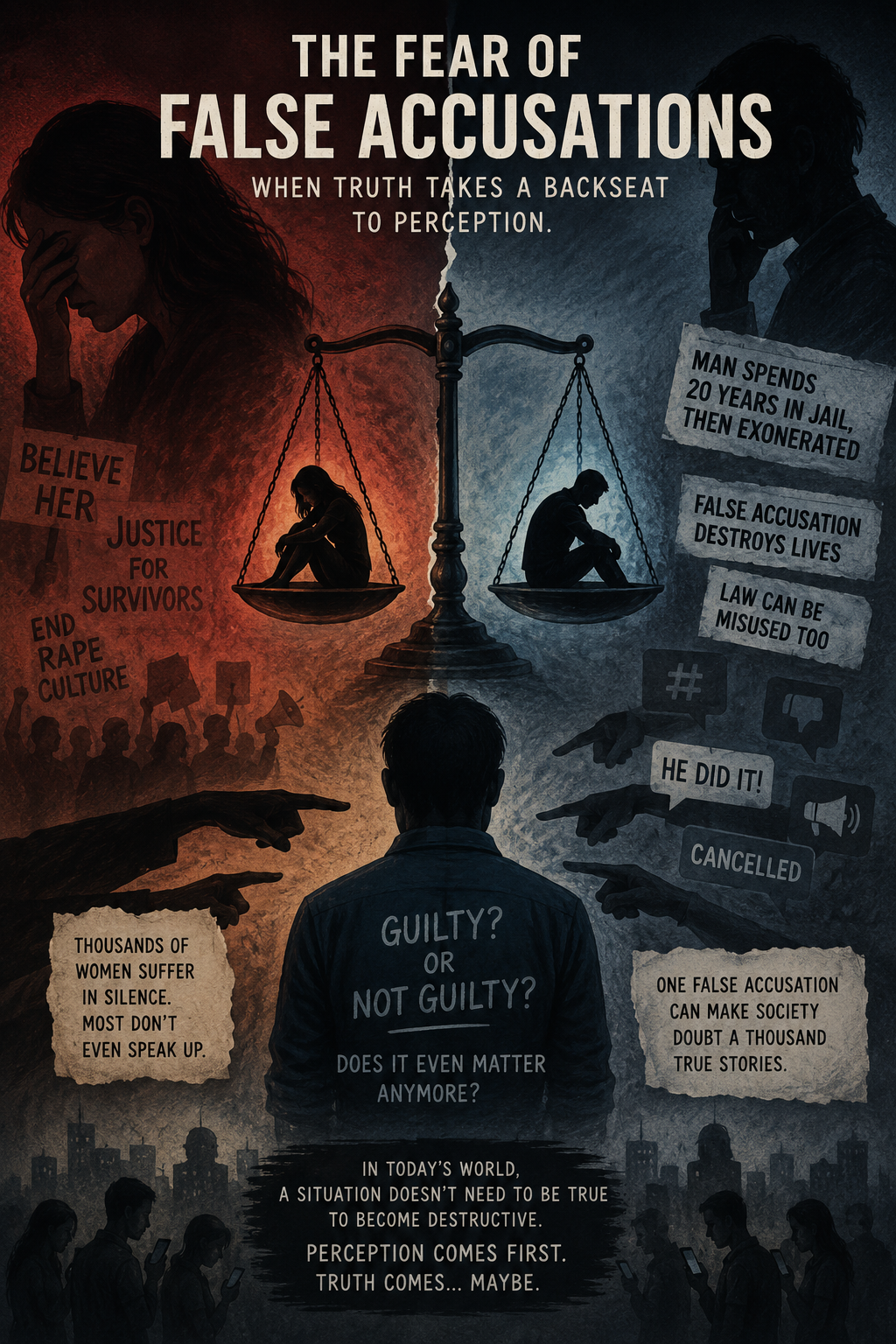
The Fear of False Accusations
For every recurring criminal issue in society, there’s always one common counterpoint — false accusations.
And honestly, it’s true. False accusations weaken the argument because what’s worse than being blamed for a crime? Getting blamed for a crime you didn’t even commit.
As a woman, let’s take a few examples of problems women face.
1. Rape
It’s a heinous crime. Thousands of women get sexually abused in some way or another every single day, and a majority of these cases go undocumented.
Why?
Because there’s fear.
Fear of judgement. Fear of not being believed. Fear of losing out on something you already have over something that has already happened to you.
But then comes the question — why does society hesitate to believe women when they come forward with experiences like this?
Because false accusations exist.
Because the world has seen cases where men have gone to jail, spent years there, and were later exonerated because the accusation made against them wasn’t real.
And I get it. I’m a man hater and all that, but this is exactly the kind of thing that radicalises other men who maybe could’ve been decent otherwise. This is the argument incels use to justify why marital rape should remain legal.
The fear of someone falsely accusing you of a crime has become strong enough for society to legalise another crime in return.
It sounds ridiculous, but in some fucked up way — it’s true.
2. Marital Rape
One of the biggest arguments against criminalising marital rape is, once again — false cases.
Now personally, I do believe the number of genuine cases far exceeds the number of false ones. But the mere fact that this is even considered a valid concern says a lot.
Divorce cases can become extremely one-sided, and while I’m not siding with men — and never will — I do understand where the fear comes from.
A very small portion of people ends up shaping how the rest of society is treated. And as absurd as that sounds, it is the truth.
One false accusation becomes enough to make people suspicious of hundreds of real victims afterward.
So why am I suddenly cribbing about this?
A friend of mine was narrating an incident from his workplace.
An employee had to be asked to leave the company, and like most people, he didn’t take it well. During the confrontation, he apparently said:
“I don’t have to talk to you. Now my gang will speak with you.”
There was an underlying threat in that statement because naturally, people don’t casually go around saying things like that.
But now the company has another concern.
This particular individual belongs to a certain community, and the organisation fears that he could give the issue a communal angle and falsely accuse the company of something they haven’t actually done.
Now whether the issue is communal or not, I genuinely don’t know because I don’t know the full story.
But I do know how these things work.
I know that the truth index of a situation has very little to do with its escalation power — and that’s what bothers me.
Because in today’s world, a situation doesn’t necessarily have to be true to become destructive.
Public perception forms first.
Facts come later.
Sometimes they never come at all.
And somewhere in the middle of all this, genuine victims suffer, innocent people become paranoid, and society slowly loses the ability to have nuanced conversations about anything anymore.

Leave a Reply