
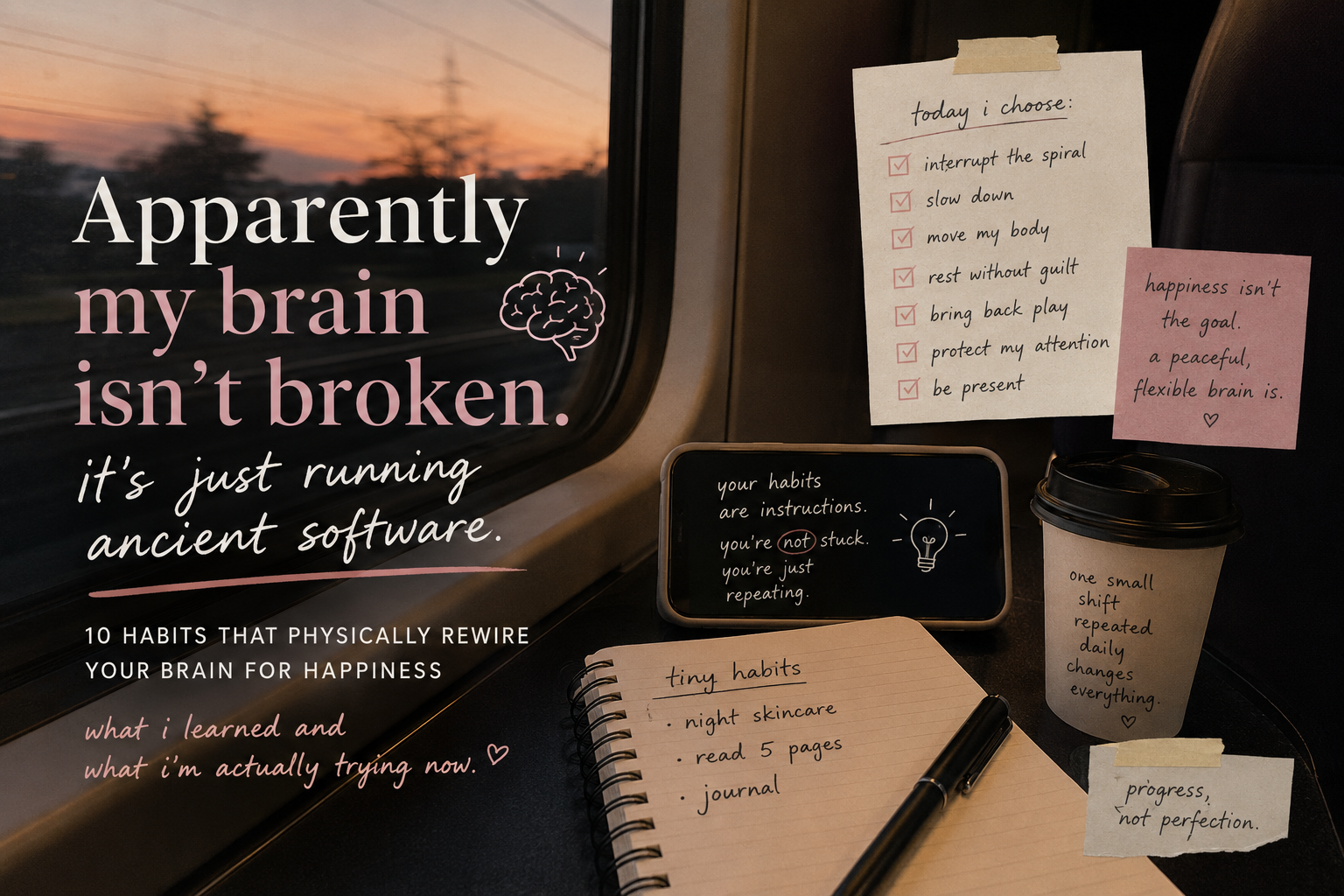
I was watching a YouTube video on my way back home from work.
Now, considering my commute is long enough to qualify as a short domestic flight, I consume a lot of content while travelling. Most of it gets forgotten before I even reach my destination.
This video didn’t.
It was called 10 Habits That Physically Rewire Your Brain For Happiness and I clicked on it expecting the usual self-improvement advice.
Wake up at 5 AM.
Drink water.
Meditate.
Become a billionaire by Thursday.
You know the drill.
Instead, the video started with a statement that immediately caught my attention:
Your brain was never designed to make you happy.
Its primary job is to keep you alive.
And suddenly a lot of things started making sense.
Why I overthink.
Why I replay embarrassing moments from years ago.
Why one small problem can feel like the end of the world at 11 PM.
Why even when life is objectively okay, my brain occasionally behaves like we’re being chased by a tiger through a forest.
According to the video, that’s not a personality flaw.
It’s ancient software running on modern hardware.
Unfortunately, that explanation made far too much sense.
The video went on to explain something called neuroplasticity, which is basically the brain’s ability to rewire itself based on repetition.
In simple terms, your habits are instructions.
Whatever you repeatedly think, feel and do becomes easier for your brain to do again.
If you repeatedly practice stress, your brain gets better at stress.
If you repeatedly practice overthinking, your brain gets better at overthinking.
Which is honestly impressive because if overthinking were an Olympic sport, I’d have enough gold medals to start my own country.
The good news is that the opposite is also true.
If you repeatedly practice calm, presence, gratitude and focus, your brain slowly starts building those pathways too.
Not overnight.
Not because you watched one motivational video.
Not because you created a colour-coded life plan at 2 AM.
But slowly.
And that’s when I realized something.
A lot of my recurring thoughts sound suspiciously similar.
“I’m behind.”
“I’m wasting time.”
“I want to get married and have babies and somehow I’m already 25.”
“I should study otherwise I’ll be stuck at this salary forever.”
“I think they don’t like me.”
Different thoughts.
Same theme.
Time is passing and I’m not where I want to be yet.
The video’s argument was simple: your brain isn’t necessarily telling you the truth. It’s trying to protect you.
Unfortunately, it sometimes protects you by convincing you that everything is on fire.
So I decided I’m going to try some of the habits from the video.
Not perfectly.
Just honestly.
Interrupting The Negative Spiral
The first habit was interrupting negative thought loops.
Not eliminating them.
Interrupting them.
Because apparently the goal isn’t to become a permanently positive person.
Thank God.
When I catch myself spiraling, I’m going to take a few deep breaths and deliberately change the topic in my head.
Not suppress the thought.
Not argue with it.
Just refuse to spend the next three hours mentally rehearsing a disaster that hasn’t happened.
Staying With Good Moments A Little Longer
The video pointed out something I had never really thought about before.
Negative experiences stick automatically.
Positive experiences don’t.
And honestly, I rush through everything.
Finishing a task.
A good skin day.
A peaceful moment.
A successful week.
A nice conversation.
Everything immediately becomes a stepping stone to the next thing.
So I’m going to try slowing down.
If I’m enjoying my skincare routine, I’ll enjoy it.
If something good happens, I’ll acknowledge it.
If I have a peaceful morning, I’ll let myself stay in that feeling for a few extra seconds before sprinting toward the next problem.
Reducing Mental Noise
For me, the biggest source of mental noise is Instagram.
Not because Instagram is inherently evil.
But because it has a magical ability to convince me that everyone else is simultaneously richer, prettier, more successful, more productive and somehow awake at 4 AM drinking green juice.
I’m not deleting it.
I’m not disappearing into the mountains.
I’m just going to try using it more intentionally.
The goal isn’t to avoid social media.
The goal is to stop letting social media decide what occupies my brain all day.
Moving More
The video recommends moving your body every day.
Now before anyone tells me to wake up at 5 AM and train for a marathon, let me remind you that I spend around five hours commuting and eight and a half hours working.
My schedule is already fighting for its life.
So my version of this habit is simple.
Walk more.
Move more.
Do something.
Because a realistic habit that happens is infinitely better than a perfect habit that exists only inside a planner.
Rest Isn’t A Crime
This habit made me think.
I don’t actually struggle with resting.
I watch Netflix.
I sleep.
I relax.
The problem is that whenever I’m awake and not actively doing something productive, a tiny manager appears inside my head.
“You should be working.”
“You should be studying.”
“You should be doing something useful.”
The video reminded me that recovery isn’t laziness.
And honestly, I needed that reminder.
Bringing Back Play
This one hurt a little.
The question was:
“What did you enjoy before life became serious?”
For me, the answer was easy.
Drawing.
Writing.
Not writing for SEO.
Not writing for traffic.
Not writing because it’s content.
Just writing because I enjoyed it.
At some point every hobby became a project.
Every project became a goal.
Every goal became pressure.
I’d like to reverse that process occasionally.
Changing The Way I Talk To Myself
This is probably the hardest habit on the list.
Because negative self-talk starts feeling factual when you’ve repeated it enough times.
“I’m behind.”
“I’m wasting time.”
Maybe a more accurate thought is:
“My timeline doesn’t look the way I expected, but that doesn’t mean I’ve failed.”
Or:
“Rest and enjoyment aren’t automatically wasted time.”
Do I fully believe those thoughts yet?
Not really.
But I suppose the old thoughts didn’t become automatic overnight either.
Protecting My Attention
The video talks about protecting your attention because whatever repeatedly captures it eventually shapes your emotions.
This one immediately made me think about certain professional interactions that leave me mentally exhausted.
Not because the people involved are bad people.
Some of them are genuinely wonderful.
But certain interactions drain more energy than they give.
I can’t always control who I interact with.
But I can be more intentional about what gets access to my attention afterwards.
Practicing Presence
My chosen mindfulness practice is skincare.
Which sounds ridiculous until you realize that most of us spend our daily routines physically present and mentally somewhere else.
We’re planning tomorrow.
Replaying yesterday.
Worrying about next year.
So instead, I’m going to try actually being there.
One cleanser.
One serum.
One moisturizer.
One human being existing in the present moment.
Groundbreaking.
Tiny Habits
The final lesson from the video was probably the most important one.
The brain changes through repetition, not intensity.
Which is great news because intensity is usually how I create unrealistic plans and abandon them three days later.
So my tiny habits are:
- Do my night skincare routine.
- Read five pages.
- Journal.
That’s it.
No life overhaul.
No dramatic reinvention.
No 37-step morning routine.
Just small things repeated consistently.
The Real Reason I’m Doing This
I watched this video today.
That’s literally the reason.
There wasn’t some major life event.
No dramatic breakdown.
No turning point.
I simply watched something that made sense and decided it was worth trying.
Will I stick to it?
Honestly, maybe.
If I had to rate my confidence level, it’s probably a 6 out of 10.
Not exactly inspiring.
But honest.
And I think honesty is a better foundation than motivation.
Because motivation disappears.
Habits don’t.
Or at least that’s what the video keeps insisting.
Six months from now, I don’t necessarily want a different job.
A different salary.
A different life.
I just want to be happy.
Not constantly.
Not perfectly.
Just more often than I am now.
And if future me reads this article six months from now and thinks,
“It feels good.”
Then I think this experiment will have been worth it.

Leave a Reply